Talleyrand: The Open-Source AI Thinking Workspace Built as a Question Tree
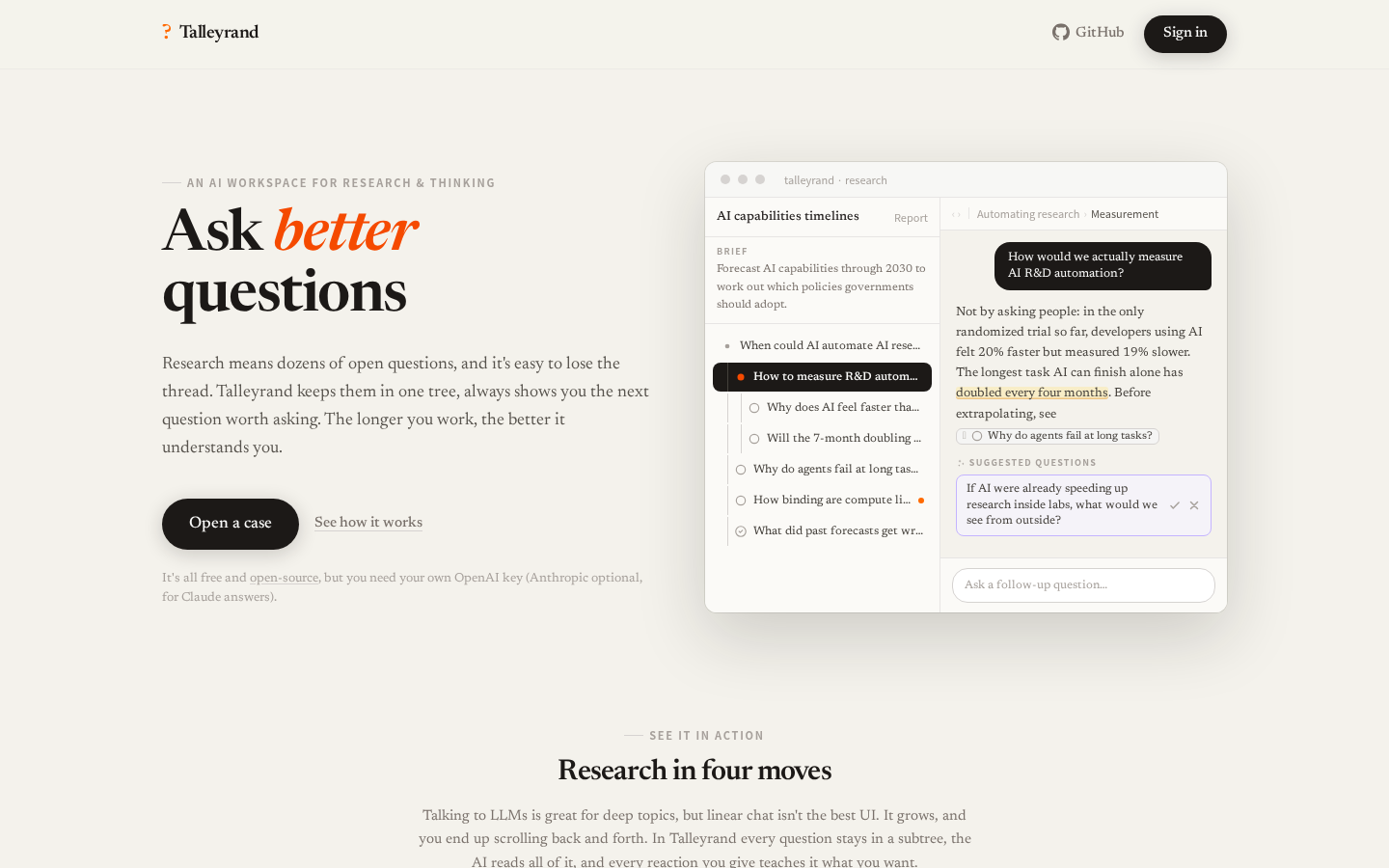
Talleyrand is a new open-source AI thinking workspace that structures conversations as a branching question tree instead of one scrolling chat thread. It was posted on Show HN by creator steshinss, who built it because a good answer often raises several follow-up questions at once that a linear chat thread makes easy to lose track of. This guide covers what changed, why the tree structure matters for long AI sessions, and who should actually try it.
Disclosure: this article contains affiliate links. If you buy through them we may earn a commission at no additional cost to you. Our recommendations are based on the evidence recorded alongside this article, and prices were verified on the date shown.
What changed and why it matters
Talleyrand went up on Show HN under the handle steshinss as an open-source AI thinking workspace built as a question tree, not a chat window. That's the checkable fact today: the live product sits at talleyrand.app, structured around branching nodes instead of one scrolling transcript.
It matters because the problem it targets shows up for anyone who runs more than a few exchanges with an LLM. The creator's stated motivation is specific: a good answer tends to raise several new follow-up questions at once, and in a normal chat thread you have to scroll back and forth to find the ones you haven't asked yet. The further the conversation runs, the easier it is to lose track of which threads are still open.
The detail
A linear chat interface — ChatGPT, Claude, most assistants — stacks every exchange in a single vertical thread. You ask a question, get an answer, and ask the next question underneath it. That works fine until one answer opens up three directions you want to explore separately. At that point you're stuck scrolling to figure out which ones you already covered and which are still waiting.
Talleyrand restructures that interaction as a tree instead of a thread. Each question becomes a node that can branch into multiple follow-ups, and each of those follow-ups can branch again, so the shape of a conversation mirrors the shape of your actual thinking rather than forcing it into a single line. The creator built this specifically because the common workaround — starting a new chat to escape the clutter — resets context completely. You end up re-reading everything you already covered just to get a fresh thread caught up.
| Linear chat | Question-tree model | |
|---|---|---|
| Tracking follow-ups | Scroll back through the full thread to find unanswered ones | Each follow-up lives on its own branch |
| Starting fresh | A new chat loses all prior context | Branches stay attached to the original context |
| Where it strains | Long sessions with multiple open threads | Not evidenced for short, single-question lookups |
Talleyrand is also positioned as open-source, which is the detail worth sitting with if you've been burned before by a closed tool that changed its pricing or shut down. The code itself is the product here, not a hosted account layered on top of someone else's black box.
What it means for you
If you spend real time interrogating one topic with an LLM — working through a system design, reading a dense document section by section, mapping out a research question across a long session — Talleyrand's tree structure is built for exactly the failure mode described above: a good answer raises three new questions, and a normal chat thread makes you choose between losing track of them or starting over and losing your context.
- Best for: anyone whose LLM sessions regularly branch into multiple unanswered follow-ups they lose track of in a scrolling thread.
- Skip it if: your LLM use is mostly one-off, single-question lookups — a tree adds structure a simple chat box doesn't need.
If this kind of project has you thinking about building or hosting your own AI-tooling interface — a question-tree workspace, a custom chat layer, or anything else sitting on top of an LLM — the hosting decision is separate from the tool decision. See [Vercel's current plans and pricing](See current pricing at the merchant) before you commit infrastructure budget to a project like this, so you know what a usage-based deployment actually costs rather than guessing.
The decision isn't whether open-source question trees are a good idea in the abstract. It's whether your own LLM habit actually produces the branching-follow-up problem Talleyrand describes. If it does, the tool is free to try at talleyrand.app. If it doesn't, linear chat was never actually broken for you, and no amount of tree structure will change that.
What this costs right now
Vercel
The last check on this price fell outside our freshness window, so no figure is shown.
Check the current price at VercelPrices move. We print the figure we read and the moment we read it, and suppress anything older than its window rather than guess at the current number.