OpenRouter's Same Model Can Cost 33x More Depending on Provider, Daily Tracker Shows
A developer's scraper snapshots OpenRouter's full catalog of 425 models from 58 providers every day and diffs it against the prior day's data. The project's headline finding is a 33x price gap between two providers selling the exact same model, not two different ones. The numbers are published daily at costpertoken.dev, so you can check the current gap yourself before assuming last week's price still holds.
Disclosure: this article contains affiliate links. If you buy through them we may earn a commission at no additional cost to you. Our recommendations are based on the evidence recorded alongside this article, and prices were verified on the date shown.
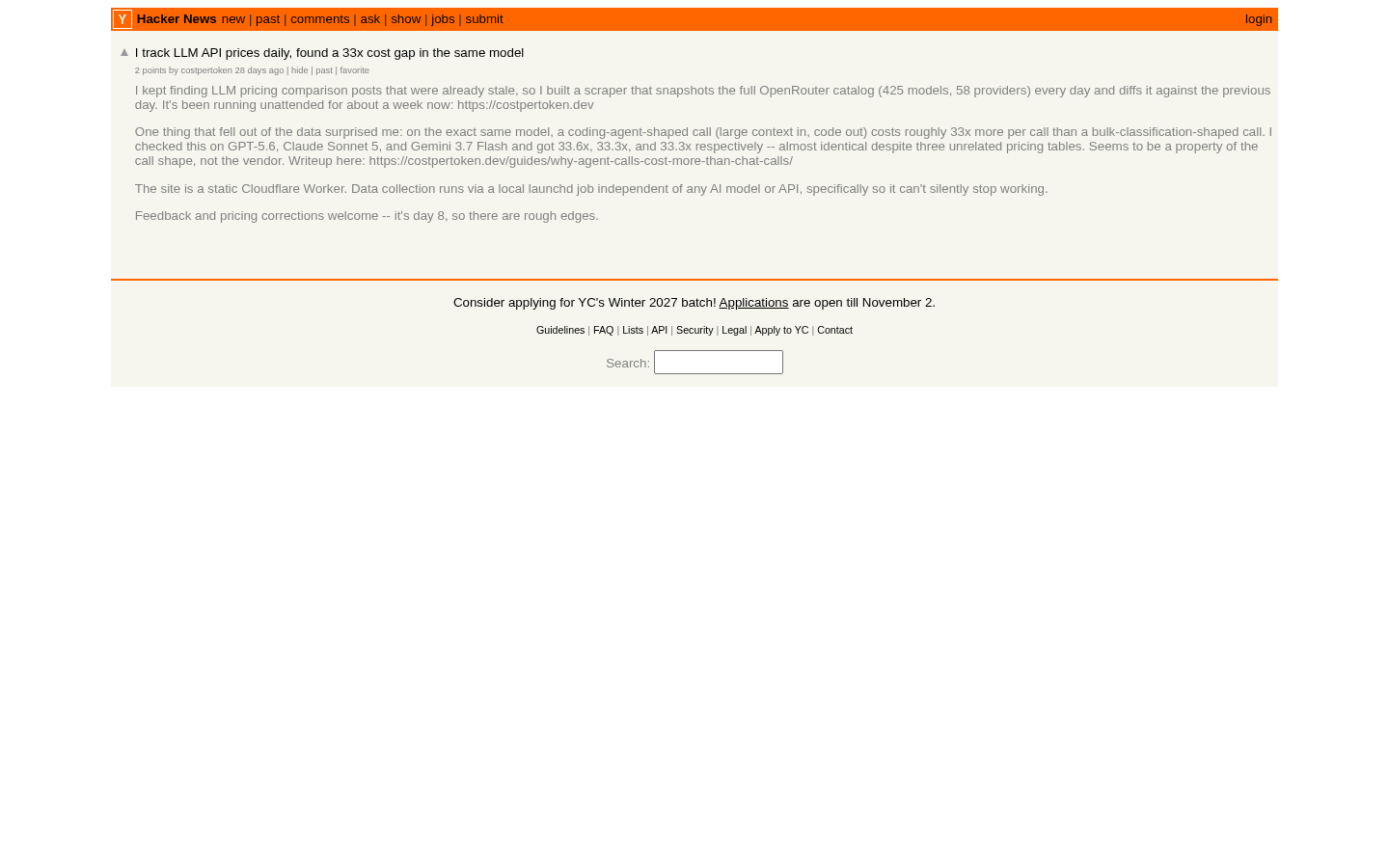
A developer built a scraper that snapshots OpenRouter's entire model catalog — 425 models across 58 providers — every day and diffs it against the previous day's snapshot (source). The project's headline finding: a 33x price gap between two providers selling access to the exact same underlying model, not two different models (source). Here's what that gap means if you're the one paying the API bill, and what it doesn't tell you.
The tracker had been running for about a week at the time the finding was posted, and it keeps updating daily (source). A gap that shows up day after day in a diff against the prior day's data is a different kind of evidence — and the project publishes its numbers at costpertoken.dev, so the comparison is checkable rather than quoted secondhand (source).
How the daily-diff approach found a gap that one-time comparisons miss
A single price comparison — one provider's rate against another's, checked at one point in time — can catch sticker-price differences between models. It's not built to catch something more specific: two providers listing the same model at wildly different per-token rates (source).
Running the comparison every day, against the prior day's snapshot, is what let the builder behind this tracker treat the 33x number as a real, persistent gap rather than a one-off scraping artifact (source). For anyone paying API bills at volume across more than one provider, that's the difference between catching a cost leak and not noticing it until the invoice arrives.
What the 33x gap covers, and what it doesn't
The finding applies to models available through more than one provider on OpenRouter's catalog — the 58 providers tracked each set their own rates for the models they host, which is what makes the same model carry different prices depending on who's serving it (source). It's a statement about that catalog and that comparison, covering 425 models at the time of the post (source).
If a model you're paying for is only available through one provider, there's no second listing to diff it against, so this finding has nothing to compare it to. The practical takeaway is narrower than "AI pricing varies by 33x" as a blanket claim — it's that the same model, listed by multiple providers on this one catalog, can carry a 33x spread between the cheapest and most expensive listing, as of this tracker's dated snapshot (source).
What it means for you
If you're already routing requests across more than one LLM provider, the lesson from this tracker is that a price comparison you ran once — even a careful one — can go stale without you noticing, because providers change their rates independently of each other (source). Checking once isn't the same as checking continuously.
That's the point where provider management becomes its own decision, separate from which model you pick. If you want a single place to see what each provider is actually charging rather than cross-referencing dashboards by hand, you can See current pricing at the merchant and compare what unified routing costs against running the comparison yourself. If you're also evaluating the coding-assistant layer that sits on top of these models, Best Continue Alternatives: How to Choose Now walks through that decision separately from the underlying model cost question.
Before assuming the price you saw last week still holds, it's worth checking the tracker's current numbers at costpertoken.dev (source) — the whole point of running the diff daily is that the answer keeps changing.
What this costs right now
Cloudflare
The last check on this price fell outside our freshness window, so no figure is shown.
Check the current price at CloudflarePrices move. We print the figure we read and the moment we read it, and suppress anything older than its window rather than guess at the current number.