OpenRouter's 33x Pricing Gap: What a Daily Price Tracker Actually Confirmed
A developer who tracks LLM API prices daily found a 33x cost gap between two providers reselling the same model on OpenRouter. The finding comes from a scraper that snapshots 425 models across 58 providers every day, built on about a week of collected data. This guide walks through what the source confirms, where it stops short of naming the model or providers involved, and where infrastructure pricing comparisons fit if you're hosting the backend behind an LLM-powered feature.
Disclosure: this article contains affiliate links. If you buy through them we may earn a commission at no additional cost to you. Our recommendations are based on the evidence recorded alongside this article, and prices were verified on the date shown.
If you call a third-party LLM through a reseller marketplace, the rate you were quoted might not be the rate everyone else pays for the same model. A developer who tracks LLM API pricing daily just caught a 33x spread between two providers reselling one model on the same marketplace, in a dataset that was only a week old.
What changed and why it matters
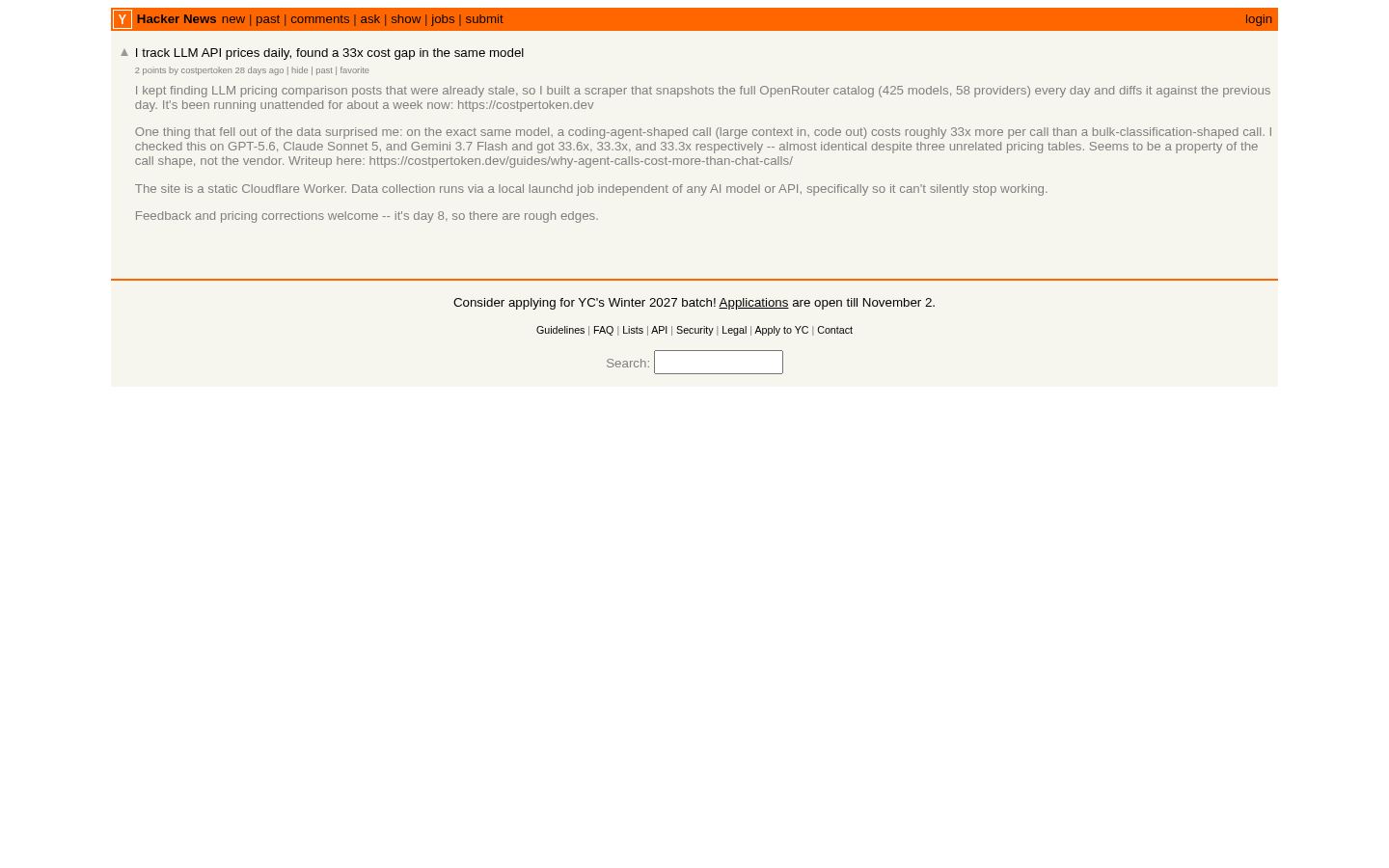
The finding comes from a Hacker News post titled "I track LLM API prices daily, found a 33x cost gap in the same model", submitted by user costpertoken on September 6, 2026. The post's author built a scraper that snapshots the full OpenRouter catalog — 425 models across 58 providers — every day and diffs it against the previous day's pricing, which is how the 33x gap got caught in the first place.
That matters beyond the headline number. OpenRouter is a marketplace where more than one provider can resell access to the same underlying model, and those providers don't always charge the same per-token rate. The lesson isn't about any one model — it's that "the price" of a widely resold model can mean several different numbers depending on which provider fills your request.
The detail
Here's what the source actually confirms, and where it stops. The scraper takes a full snapshot of OpenRouter's catalog once a day and compares it to the prior day's snapshot, which is how price changes and gaps between providers get surfaced automatically instead of by hand. At the time of the September 6 post, that scraper had been running for about a week.
The 33x figure is the largest gap the author's data had caught in that short window: the same model, sold by more than one provider on the same platform, priced 33 times apart, according to the original Hacker News post. The text of the post available to us cuts off before it names which model produced that number or which two providers were on either end of it, so this piece cannot confirm which specific model or providers produced the 33x figure.
| What's confirmed | Detail from the source |
|---|---|
| Models monitored | 425, across the OpenRouter catalog |
| Providers monitored | 58, reselling access to those models |
| Update method | Daily full-catalog snapshot, diffed against the prior day |
| Data history at time of posting | About one week |
| Where to check current rates | costpertoken.dev |
That last row is the one worth acting on. A week of data is enough to catch a gap, not enough to call it a stable pattern. The tracker itself, published at costpertoken.dev, is built to show current per-model, per-provider rates rather than a single point-in-time screenshot — so if you want today's number for a model you actually use, that's the place to look instead of quoting a week-old post.
What it means for you
The practical takeaway isn't "avoid provider X" or "pick provider Y" — the evidence doesn't go that far. What is confirmed is the mechanism: on a marketplace with 58 providers and 425 models, the same model can carry multiple prices, and only a tool that checks daily will catch when those prices drift apart. Before you build a cost projection around one quoted rate, check whether that rate is the only one on offer for the model you're using.
That same discipline applies to the infrastructure sitting underneath your API calls, not just the per-token rate. If you're running an LLM-powered feature, agent, or coding assistant from your own backend, the servers and databases hosting that backend are a second cost line that's just as easy to overpay for without a current comparison. If you're also evaluating which AI coding assistant to standardize on, our guide to choosing a Continue alternative applies the same approach: compare published criteria, not the first number you see.
Where DigitalOcean fits is on that infrastructure line. If you're hosting the servers, databases, or app platform that call an LLM through a marketplace like OpenRouter, you can [see DigitalOcean's current pricing](See current pricing at the merchant) to check droplet, managed database, and App Platform rates against whatever you're paying for the same workload today.
Skip DigitalOcean if you're already locked into another provider through existing contracts, reserved pricing, or compliance terms — moving infrastructure to chase a lower list price isn't worth breaking an agreement already in place. It's worth the look if you're standing up new infrastructure for an LLM-backed product and haven't yet compared current rates against what you're about to commit to.
The broader point the costpertoken dataset makes, even at a week old, is that none of these prices are fixed numbers you can memorize. Checking a live tracker — for model pricing or for the infrastructure running it — costs a few minutes. Committing to a rate you saw once, without checking it twice, tends to cost more.
What this costs right now
DigitalOcean
The last check on this price fell outside our freshness window, so no figure is shown.
Check the current price at DigitalOceanPrices move. We print the figure we read and the moment we read it, and suppress anything older than its window rather than guess at the current number.