MaskShift: A Zero-Dependency Coding Agent Harness for Node 22
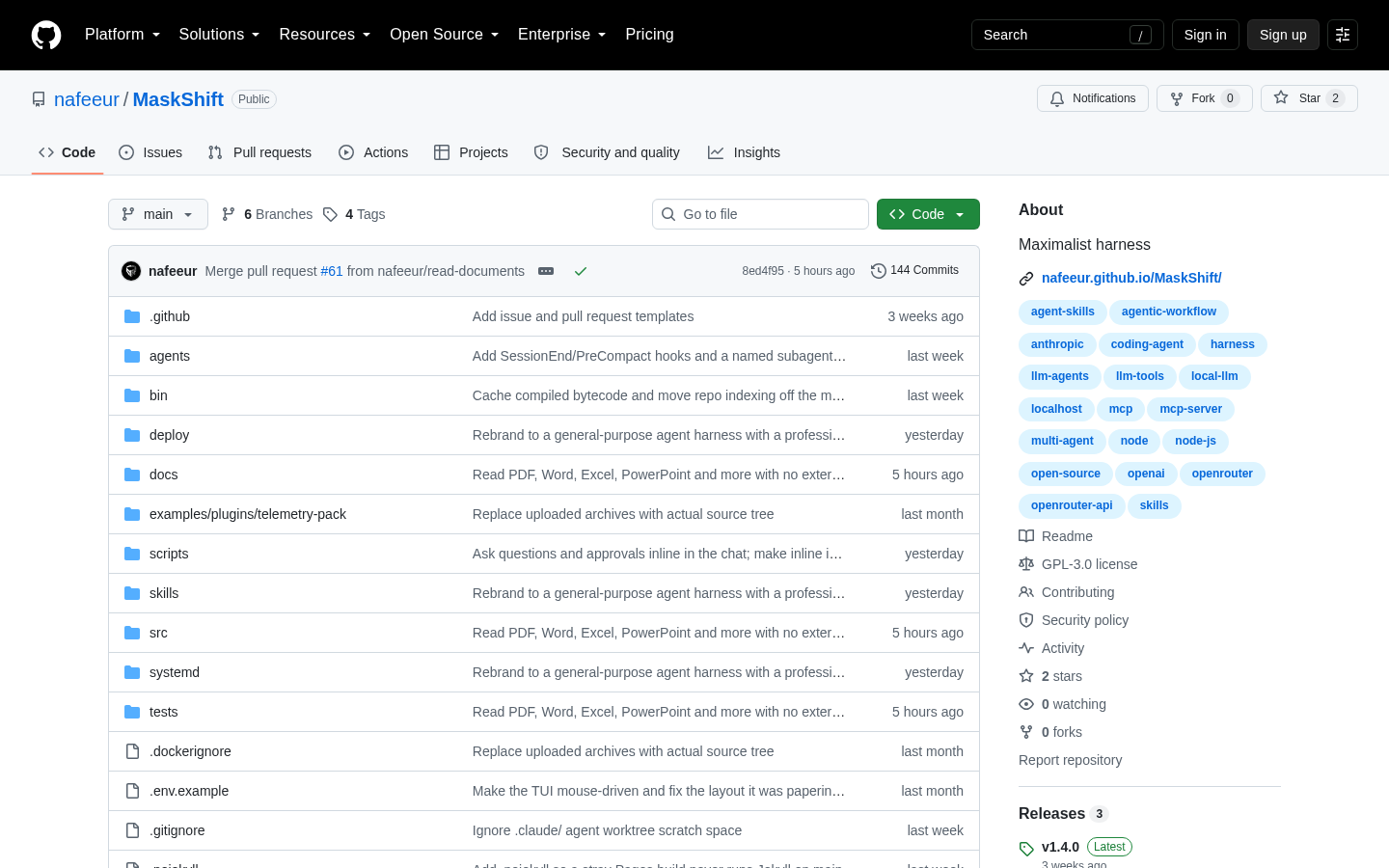
MaskShift is a local-first coding agent harness whose daemon, per its GitHub repository, runs on Node 22 built-ins only with zero npm runtime dependencies. Install is a file copy plus a symlink, and it works without native tool-calling APIs by embedding tool schemas in the system prompt. It supports multiple providers, including Ollama and OpenAI, which matters if you already run models through either.
Disclosure: this article contains affiliate links. If you buy through them we may earn a commission at no additional cost to you. Our recommendations are based on the evidence recorded alongside this article, and prices were verified on the date shown.
What changed and why it matters
A Show HN submission landed with a specific, checkable claim: MaskShift's daemon runs only on Node 22's built-in modules, with zero npm runtime dependencies (MaskShift repository). That's a claim you can verify by reading the repository's own dependency manifest rather than taking anyone's word for it, which is exactly why it's worth a close look instead of a skim.
The project was submitted to Hacker News by a contributor credited as Nafeeur, and the GitHub repository at github.com/nafeeur/MaskShift is the primary record of what the tool does and how it's installed (primary source). If the phrase "Node 22" brought you here because of this thread, the actual news is the dependency count and the install method it enables, not a new Node.js release itself (zero-dependency build).
The detail
MaskShift is described as a local-first coding agent harness. Two words matter in that description. "Local-first" means it runs on your own machine rather than as a hosted product you sign into. "Harness" means it's infrastructure for running an agent against a model, not the model itself.
The install method follows directly from the zero-dependency design. Instead of an npm install step that resolves a tree of transitive packages, setup is a file copy plus a symlink (install detail). There's no package manager running in the background during setup, and consequently no npm supply chain to audit for this particular tool — whatever security posture you have, it isn't inherited from a dependency tree here.
The more interesting engineering decision is how MaskShift handles models that don't expose a native tool-calling API. Rather than requiring a provider-specific function-calling format, it writes the tool schemas directly into the system prompt sent to the model. The model's reply includes a block describing the call it wants to make, and MaskShift parses that block back into a normal tool call (tool-calling detail). That one mechanism is what lets it support multiple providers — including Ollama and OpenAI — without maintaining a separate integration for each provider's native API shape.
| What you're evaluating | What the evidence states |
|---|---|
| Runtime dependencies | Zero npm packages; daemon uses Node 22 built-ins only |
| Install method | File copy + symlink, no npm install step |
| Tool-calling support | Works without native tool-calling APIs, via schemas embedded in the system prompt |
| Model providers | Multiple, including Ollama and OpenAI |
None of this is a benchmark or a performance claim. The repository doesn't publish speed, accuracy, or token-cost numbers, so none of those are repeated here. What's documented is the architecture: fewer moving parts to install, update, or have break under you when a transitive dependency changes behavior.
What it means for you
If you're running or evaluating an OpenAI-backed coding workflow, MaskShift's relevance to your decision isn't really the agent itself — it's the pattern behind it. A tool built to avoid a dependency chain is built to avoid a specific class of failure: a transitive package going stale, getting pulled, or shipping a vulnerability nobody on your team signed up for. That's a reasonable thing to care about whether the agent runs on your laptop or the application behind it runs in production.
Best for: developers who already call models through Ollama or OpenAI and want a lighter-weight harness to test, where fewer installed packages means a smaller surface to patch and audit.
Skip it if: you need a managed, hosted agent product with a support contract and a graphical interface — MaskShift, as described in its repository, is a self-installed local harness, not a hosted service.
The same reasoning extends one level up, to where you run the AI-backed application once it leaves your machine. Hosting choices carry their own dependency and maintenance trade-offs, just at the infrastructure layer instead of the npm layer. If you're weighing where to deploy an OpenAI-integrated project, you can See current pricing at the merchant and see exactly what tiers and limits apply before you commit to one.
The decision in front of you isn't whether MaskShift is "good" — its own repository doesn't give you a benchmark to settle that. It's whether a dependency-free, provider-agnostic harness fits how you already work, and whether the hosting platform behind your model-backed app gets the same scrutiny you just gave this one.
What this costs right now
Vercel
The last check on this price fell outside our freshness window, so no figure is shown.
Check the current price at VercelPrices move. We print the figure we read and the moment we read it, and suppress anything older than its window rather than guess at the current number.