LLM Agent Skills Leak Credentials: What a New Study Says
A paper titled 'Credentials Are Leaked by LLM Agent Skills: An Empirical Study' is now listed on arXiv, naming credential exposure in AI agent skills as a measured risk. It matters because agent skills hold API keys and tokens to call services on your behalf, and a leak can expose secrets in logs or unintended endpoints. This piece explains what the paper's title confirms, what isn't detailed here, and what to check in your deployment platform's secret handling.
Disclosure: this article contains affiliate links. If you buy through them we may earn a commission at no additional cost to you. Our recommendations are based on the evidence recorded alongside this article, and prices were verified on the date shown.
What changed and why it matters
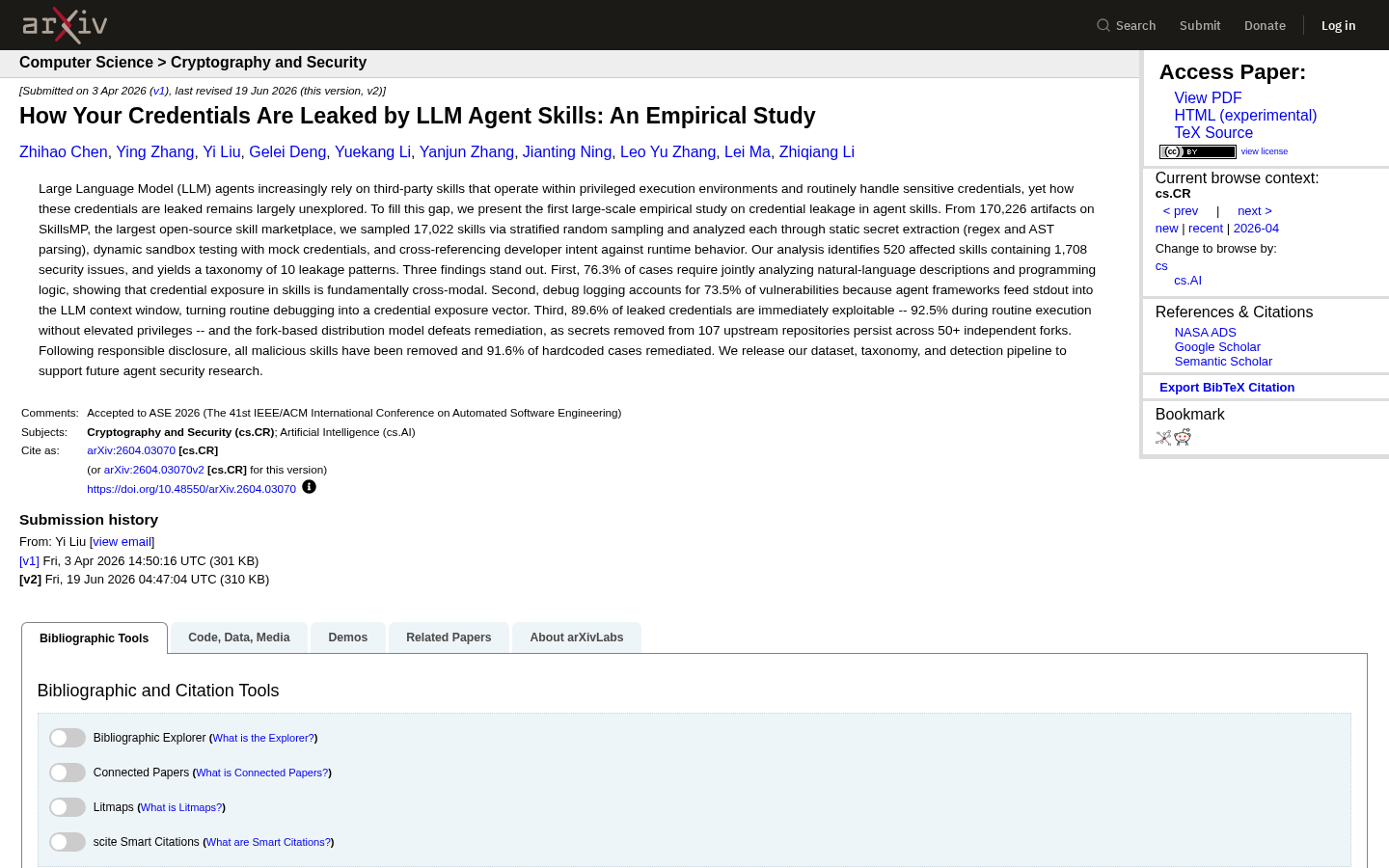
A paper titled "Credentials Are Leaked by LLM Agent Skills: An Empirical Study" is now listed on arXiv at https://arxiv.org/abs/2604.03070. The title alone states the finding without hedging: agent skills — the plug-in modules that let AI agents act on your behalf — leak credentials, and the study treats this as a measured, empirical problem rather than a hypothetical one.
That framing matters because agent skills have moved from research demos into daily tooling. Anyone running an AI agent that connects to a calendar, a database, a payment API, or a deployment pipeline is running code that, by design, needs to hold and use secrets. A study naming credential leakage directly is a signal worth acting on if any part of your stack touches agent skills, plugins, or third-party AI tooling with live-system access.
The detail
An "agent skill," in this context, is a packaged capability an LLM-based agent loads to do a specific job: call an API, read a file, send a message, trigger a deployment. To do that job, the skill typically needs an API key, an OAuth token, or another credential scoped to the service it talks to. That credential has to live somewhere the agent can reach it — in an environment variable, a config file, or a value passed into the skill at runtime.
"Leaked," in a study like this, generally means one of two things: the credential ends up somewhere it shouldn't (logs, prompts sent to a model provider, an unintended third-party endpoint), or a skill that should only see a narrowly scoped credential ends up with broader access than it needs. Both are failure modes that are easy to miss during normal development, because the agent keeps working right up until the moment a secret shows up somewhere it was never supposed to be.
This piece cites the paper's listing page on arXiv, not its full findings — the specific leak mechanisms, how many skills were tested, and how severe the exposure was are documented inside the study itself, and those numbers aren't extracted here. What the title confirms, reliably, is that this is now a named, studied risk category rather than an assumption.
What it means for you
If you build, deploy, or maintain anything that plugs an LLM agent into live systems, credential handling isn't a detail you patch after launch — it's an infrastructure decision you make before you ship. That means picking a deployment platform where secrets are scoped per project and per environment, where preview deployments don't inherit production credentials by default, and where you can rotate a key without redeploying your entire stack by hand.
This is also a business-model question, not just a technical one. Before you commit to building AI agent tooling as a core product line, it's worth reading Choosing a Resilient Business Model in the AI Era: A Hacker News Framework, which walks through how teams are deciding whether AI-agent-adjacent products can hold up as the AI landscape shifts under them.
On the infrastructure side, Vercel is one of the platforms built around exactly this class of problem: environment variables scoped by environment, project-level access controls, and a deployment pipeline designed so a preview build doesn't quietly inherit production secrets. If you're evaluating where to host agent tooling that needs to manage credentials safely, you can [see current pricing at Vercel](See current pricing at the merchant) and check the specific environment and team-plan limits against what your project needs.
Best for: teams already running or building LLM agent skills that call external APIs and need environment-scoped secret management as part of the deployment platform, not bolted on afterward.
Skip it if: you're not deploying agent tooling to a hosted platform at all — for example, running everything in a fully self-managed, on-premises environment where Vercel's deployment model doesn't apply.
The decision isn't whether credential leakage in agent skills is a real, named risk — the paper's existence on arXiv settles that. The decision is whether your current deployment setup treats secret scoping as a platform-level control or as something each skill has to get right on its own.
What this costs right now
Vercel
The last check on this price fell outside our freshness window, so no figure is shown.
Check the current price at VercelPrices move. We print the figure we read and the moment we read it, and suppress anything older than its window rather than guess at the current number.