How to Choose Show HN Revenue Agents (Including Vercel)
A Show HN post titled "Revenue Agents that monitor churn, upsell, and deal risk" introduced Rimplo, which pulls CRM, billing, support, and product-usage data into one view. It matters because the post came from Rimplo's own founder, not an independent reviewer, so its claims need separate verification. A direct capture of Rimplo's homepage on 2026-08-28 found no published pricing, so this guide lays out what to check first: data coverage, independent proof, and cost.
Disclosure: this article contains affiliate links. If you buy through them we may earn a commission at no additional cost to you. Our recommendations are based on the evidence recorded alongside this article, and prices were verified on the date shown.
Rimplo is a Show HN launch: a set of "revenue agents" that its founder says monitor churn, upsell opportunity, and deal risk in one place. If you're deciding whether to adopt a packaged tool like this or build the same monitoring yourself, this guide is for you. Skip it if you need audited pricing and independently verified case studies today — for this product, neither exists yet.
What changed and why it matters
A Show HN post titled "Revenue Agents that monitor churn, upsell, and deal risk" introduced Rimplo. Its stated pitch is that it pulls data from CRM, billing, support, and product-usage tools into one system, rather than leaving those signals scattered across separate dashboards that different teams check on different schedules and rarely compare side by side. That's the core promise: one combined view instead of four disconnected ones, built specifically around the three signal types named in the post's own title.
The post was submitted by a user identified as Hoss-Elkhateeb, who describes a background leading go-to-market teams. That detail matters for how you should read everything else on the page. This is a founder describing their own product on a public forum, not an independent reviewer, an industry analyst, or a documented customer case study. Domain experience can inform good product decisions and shape which problems a founder chooses to solve, but it isn't evidence that the product performs as described — those are two separate questions, and a launch thread only ever answers the first one.
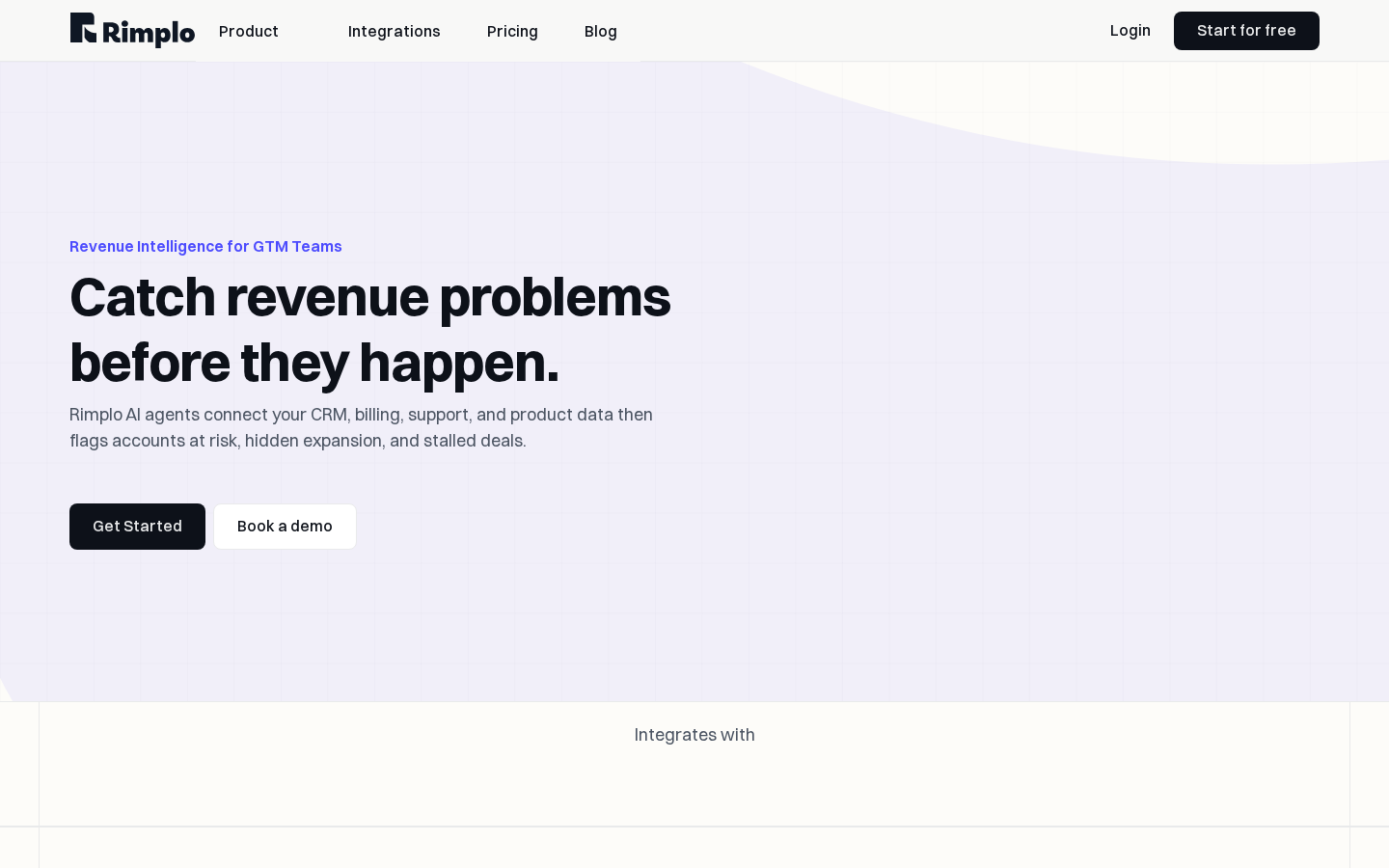
A direct capture of Rimplo's homepage on 2026-08-28 could not extract any pricing, plan limits, or itemized feature list. The positioning is public; the specifics that would let you compare it against alternatives, budget for it, or negotiate on it are not, at least not from that page on that date. That gap is normal for a fresh launch, but it changes what you can responsibly conclude about the product right now, and it's the reason the rest of this guide focuses on what to verify rather than repeating the pitch as settled fact.
What to look for
Before you commit to any revenue-monitoring tool, packaged or self-built, run it against the same checklist, in priority order. The goal isn't to reject early-stage products outright — plenty of good tools launch with thin public documentation — it's to know exactly which claims you're taking on faith versus which ones you've confirmed yourself.
| Criterion | Why it matters | What to check |
|---|---|---|
| Data sources actually connected | A tool that claims to unify CRM, billing, support, and product usage is only useful if those connections are live today, not planned for a future release | Ask which integrations ship now versus which are roadmap items, and get that distinction in writing before you sign anything |
| Signal types covered | Churn, upsell, and deal risk are three different analytical jobs; a tool can be strong on one and thin on the other two | Ask for a worked example of each signal type against real data, not just the category name on a landing page |
| Independent verification | A Show HN post is the founder's own description of their product, written to generate interest, not a review | Look for customer references, published case studies, or third-party writeups before you weight the pitch heavily in your decision |
| Founder background | Relevant domain experience is a reasonable signal of product judgment | Treat it as context for how the product was designed, not as proof of how accurately it performs against your data |
| Published pricing and plan limits | You can't budget, compare, or negotiate against numbers that don't exist publicly | Go to the vendor's own pricing page directly; never estimate a figure that hasn't been published anywhere |
That order isn't arbitrary. Data coverage and signal accuracy determine whether the tool solves your actual problem in the first place; independent verification determines whether you can trust what the vendor says about it; pricing determines whether any of that is affordable for your team. Checking pricing first, before you've confirmed the first two hold up, is how buyers end up locked into a tool that doesn't fit their stack or their budget once the trial period ends.
Recommended options
Rimplo — best for teams that want a single view of churn, upsell, and deal-risk signals without building the underlying integrations themselves, and who are comfortable being an early adopter of a just-launched product where the pricing and feature set may still be settling. The pitch — pulling CRM, billing, support, and product-usage data into one system — targets exactly the fragmentation problem most revenue teams already have, where each signal lives in a different tool that nobody checks together. Skip it if you need audited pricing, a public plan comparison, or a third-party case study before you buy; none of that is available from the Show HN post or the vendor's own homepage as of this capture, and choosing it today means committing based on the founder's description alone.
A self-built monitoring stack — best for teams with engineering capacity to pull data from their own CRM, billing, support, and product-usage APIs and combine it into a custom dashboard they control end to end, on infrastructure they choose and can scale on their own schedule. This route trades a longer setup for full control over the logic that decides what actually counts as a churn or deal-risk signal in your business, which matters if your definitions don't match a generic vendor's assumptions. Skip it if you don't have the engineering time to build and then maintain those integrations as your CRM, billing, or support tools change their APIs out from under you — a packaged agent will get you a working view faster, even if it's less tailored to your business logic.
Whichever path you lean toward, ask for the same proof before you commit: a working example against data that resembles yours, a clear list of what's connected today versus planned, and a number you can put in a budget. A vendor that can't produce those isn't necessarily wrong for you, but it does mean you're buying ahead of the evidence.
Common mistakes
Buyers evaluating tools like this most often make the same handful of errors.
First, treating a Show HN launch post as an independent review. It's the founder's own framing of their product, written to generate interest and traffic — useful for understanding the pitch and the intended use case, but not a substitute for a case study, a reference customer, or a hands-on trial with your own data.
Second, assuming a live product has public pricing simply because it's live. This capture of Rimplo's homepage found none. Don't estimate a number, and don't soften that gap with words like "around" or "roughly" — go find the actual published figure, or ask the vendor directly, before you build a budget around a guess.
Third, confusing a category claim with a confirmed integration. "Connects to CRM, billing, support, and product usage" describes what the product is designed to do, not necessarily what it already connects to for your specific tools. Confirm the actual integration list before assuming your stack is covered on day one.
Fourth, weighing founder credibility as if it were product evidence. A background leading go-to-market teams is a reasonable signal that someone understands the problem being solved. It says nothing about data accuracy, uptime, or how the product performs once it's ingesting your real CRM and billing data at volume.
Fifth, choosing the self-built route without pricing the infrastructure it will run on first. If you're weighing whether to build your own monitoring stack instead of buying a packaged agent, you can [see current pricing at Vercel](See current pricing at the merchant) before you commit engineering time to that decision — that's where you'll find the actual hosting costs to weigh against a vendor's asking price, once that price is published.
Get the integration list and a real number in writing before you pick a side. The category — one view instead of four scattered ones — is worth solving either way; which vendor or stack solves it for you should come down to evidence you've confirmed yourself, not a launch post you took at face value.
What this costs right now
Vercel
The last check on this price fell outside our freshness window, so no figure is shown.
Check the current price at VercelPrices move. We print the figure we read and the moment we read it, and suppress anything older than its window rather than guess at the current number.