Choosing a Resilient Business Model in the AI Era: A Hacker News Framework
A Hacker News thread asks which business model class is most resilient as AI reshapes markets inside three-month cycles. This guide unpacks the original poster's warning that even businesses with traction face crapshoot-level uncertainty, then turns that warning into five criteria for judging any model, vendor, or infrastructure commitment. Use the criteria and the common-mistakes checklist below before you sign a contract or lock in a budget.
Disclosure: this article contains affiliate links. If you buy through them we may earn a commission at no additional cost to you. Our recommendations are based on the evidence recorded alongside this article, and prices were verified on the date shown.
What changed and why it matters
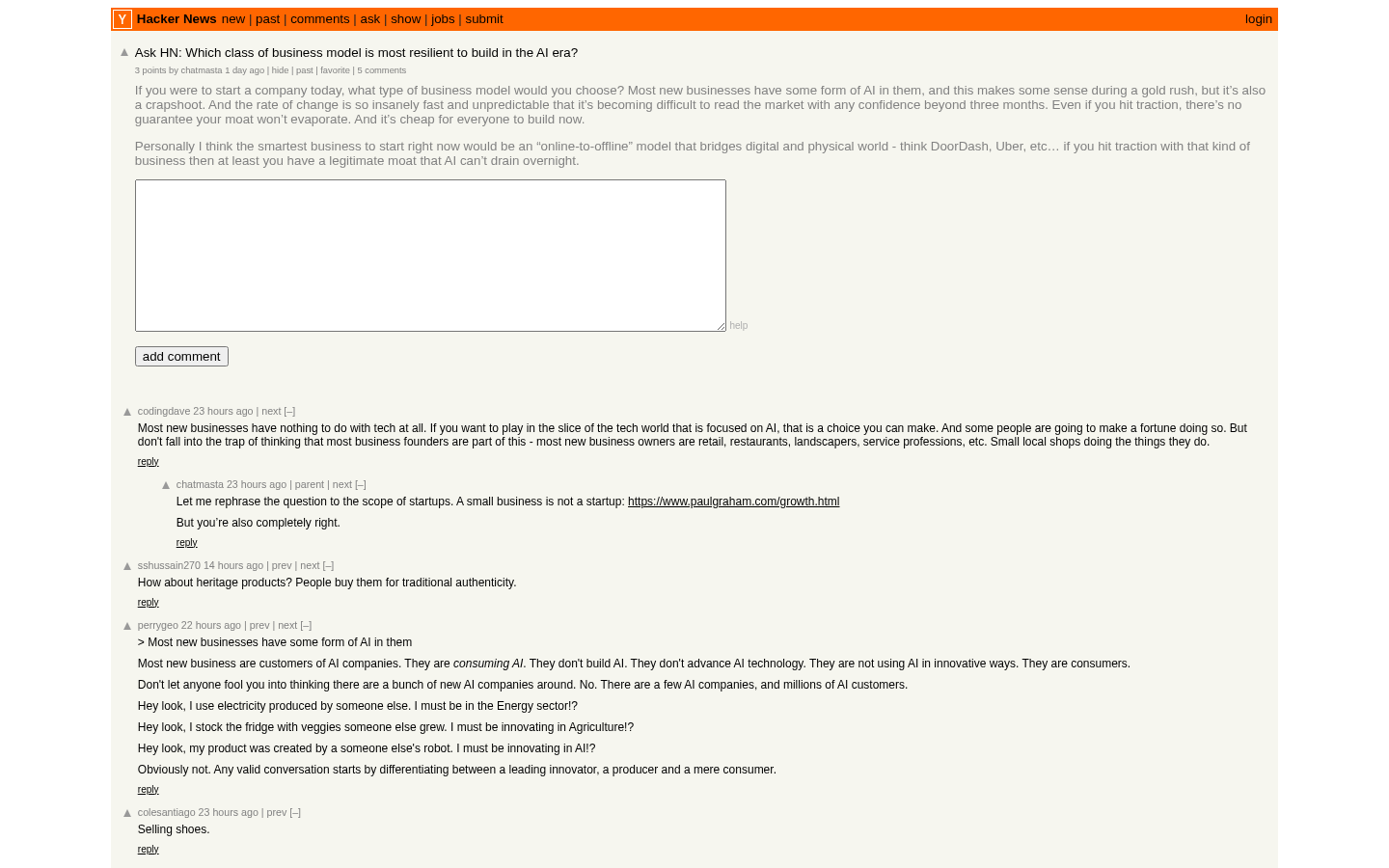
User chatmasta posted "Ask HN: Which class of business model is most resilient to build in the AI era?" on Hacker News. The question is framed around a specific fact: almost every new company now ships with some form of AI built in, which makes "pick a resilient model" a harder question than it was even two years ago.
The post names the real problem underneath that question. Its author says the pace of AI-driven market change makes it hard to forecast with confidence beyond roughly three months, and that this holds even for businesses that already have traction. In the poster's own words, that traction still leaves you at "crapshoot"-level uncertainty. If you're deciding where to put engineering time, cash, or a cloud budget, a three-month horizon should change how you weigh every option in front of you — including the infrastructure you build on.
What to look for
The original thread doesn't hand you a scored checklist, but its stated concern — a three-month confidence window, even with traction — implies a clear priority order for evaluating any model or vendor you're about to commit to.
- Monthly burn versus runway. A lower fixed cost buys you more three-month cycles before you have to be right.
- Switching cost. If the AI model or vendor underneath your product changes, how much of your business logic has to be rewritten?
- Revenue independence from one AI capability. A model that works only because of today's specific model quality or price is exposed to the next model release.
- Elasticity of your infrastructure. Can you scale spend down as fast as you scaled it up, without penalty?
- Time-to-pivot. If your core assumption breaks inside the three-month window the post describes, how many weeks does a working alternative take to ship?
Rank your options against these five before you rank them against anything else — including price.
Recommended options
These are the broad classes of business model implied by the thread's own framing, mapped against the criteria above. None of these has independently verified traction data in the source thread; the mapping below is a way to reason about the criteria, not a scored recommendation.
| Model class | Resilience driver | Skip it if |
|---|---|---|
| Infrastructure/tooling sold to AI builders | Demand grows even when the winning model changes, since builders always need somewhere to run and ship | You have no distribution into developer or technical buyer channels |
| Services wrapped around AI implementation | Revenue isn't tied to owning a model or a specific AI feature | You want a model that scales without adding headcount |
| Vertical software with a proprietary data moat | Data ownership survives a model swap; the underlying AI is replaceable | You don't yet have a defensible, exclusive data source |
| Thin wrapper apps built on a single AI API | Smallest build surface, since the app is a layer over one API by definition | Your only differentiation is the prompt, not the data or workflow |
Whichever class you're weighing, the post's own three-month framing argues for keeping your infrastructure layer cheap and disposable while the model is still unproven. That's the practical case for testing on pay-as-you-go compute instead of locking into a long contract before you've validated anything.
Common mistakes
Treating traction as proof. The original poster explicitly says traction doesn't remove the uncertainty — it's still crapshoot-level, in their words. Don't let early revenue talk you into a long infrastructure or vendor commitment you haven't stress-tested against a model change.
Locking in before the three-month window closes. Reserved-capacity contracts, annual vendor deals, and hard-to-unwind data pipelines all assume a forecast horizon the post says doesn't exist yet for AI-integrated businesses. Match your commitments to the horizon you can actually see.
Ignoring switching cost until it's expensive to fix. If replacing the AI model underneath your product requires rewriting your core logic, you've built the lock-in the thread is warning against, even if you never signed a contract for it.
Guessing at infrastructure cost instead of checking it. Before you size a monthly budget around any of the model classes above, [review current DigitalOcean pricing for compute and hosting](See current pricing at the merchant) so the number you're planning around is the number you'll actually pay, not an estimate.
The decision
The thread doesn't resolve to a single winning model, and neither does this guide — that's the point of a three-month forecasting horizon. What it does resolve to is a filter: rank any business model or vendor commitment by burn rate, switching cost, and pivot speed before you rank it by anything else, and keep the infrastructure underneath it as reversible as the model choice itself needs to be.
What this costs right now
DigitalOcean
The last check on this price fell outside our freshness window, so no figure is shown.
Check the current price at DigitalOceanPrices move. We print the figure we read and the moment we read it, and suppress anything older than its window rather than guess at the current number.