Agentic Development Fallacies: The Infrastructure Assumptions Costing Teams
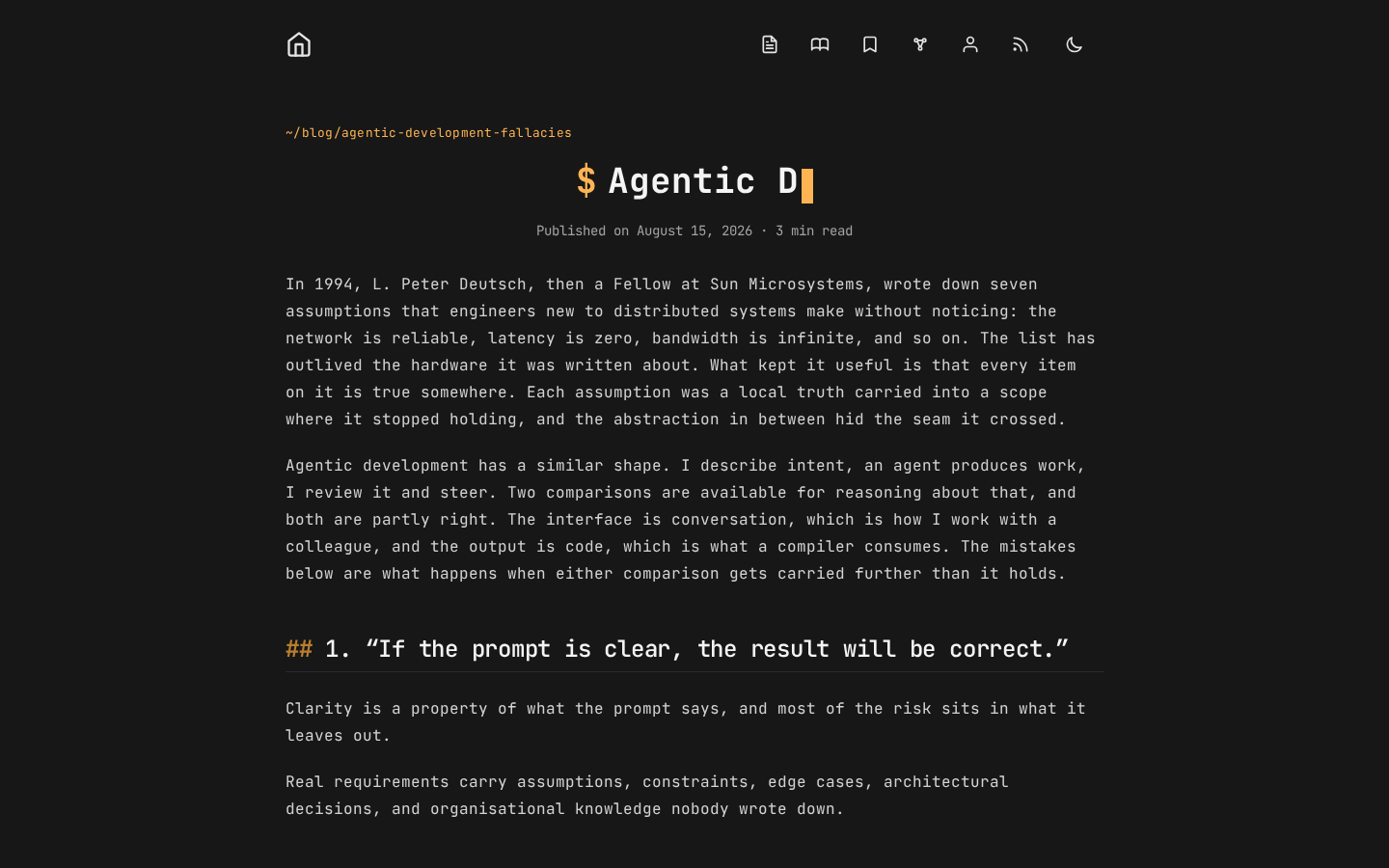
A new analysis from thuva4.com names three assumptions teams make once AI agents start writing and shipping code. It argues a single successful run is not proof of reliability, that removing human review just relocates the failures review used to catch, and that hosting built for occasional human pushes buckles under an agent opening dozens of preview branches a day. It also weighs Vercel's Pro and Enterprise tiers against what an agent-scale pipeline needs now.
Disclosure: this article contains affiliate links. If you buy through them we may earn a commission at no additional cost to you. Our recommendations are based on the evidence recorded alongside this article, and prices were verified on the date shown.
What changed and why it matters
thuva4.com published "Agentic Development Fallacies," an article addressing common misconceptions in AI-agent-driven software development (read the source analysis). The piece exists because teams are shipping code through autonomous or semi-autonomous agents faster than their processes, review habits, and infrastructure choices have adapted to match.
That gap matters beyond the article itself. As the piece lays out, every team running an agent-driven workflow is making infrastructure decisions — where the agent deploys, how previews get reviewed, who owns rollback when something breaks at 2 a.m. — based on assumptions about what these systems actually do. When those assumptions are wrong, the cost doesn't show up in the demo. It shows up later, in a production incident, in a postmortem, or in a compliance review nobody scheduled for this quarter.
The detail
"Agentic development" describes writing, testing, and shipping code where an AI agent handles steps a human previously owned directly: generating a diff, opening a pull request, running a build, sometimes merging it without anyone reading the whole thing first. The fallacies the article names aren't about whether agents can do this — they clearly can, in narrow, well-scoped slices. They're about what teams wrongly assume follows from that capability.
The first fallacy is treating a single successful run as proof of reliability. An agent that produces a correct diff once, or a dozen times, hasn't demonstrated it will do the same under a changed schema, against a codebase it hasn't seen, or under load.
The second is assuming less human review automatically means more velocity. Removing a reviewer removes a checkpoint. It doesn't remove the failure modes that checkpoint used to catch — it just relocates them downstream, to whoever discovers the broken build, the leaked credential, or the silent regression next. That person is usually further from the original context than the reviewer would have been.
The third fallacy is treating the deployment target as an afterthought, as if any hosting setup absorbs an agent that opens dozens of preview branches a day with the same grace it absorbs a person's occasional push. That's the fallacy with a direct infrastructure answer, because — as the article details — agent-driven pipelines generate a genuinely different traffic pattern than human-driven ones: more branches, more preview deploys, more automated builds running on a schedule nobody set by hand.
If your team is already running that kind of pipeline against production, Check current price for Vercel Enterprise and see whether the support tier and governance controls match what an agent-scale workflow actually needs, rather than what a single developer's laptop needed two years ago.
For readers comparing tooling built specifically for coordinating agent-driven shipping, Show HN: Agentic Ship compared, which one is worth buying walks through the options side by side, which is a useful next stop once you've placed your own workflow against the fallacies above.
What it means for you
The practical question isn't whether to adopt agentic development — most teams already have, in some form, whether or not they'd call it that. The real question is whether the platform underneath it was chosen for a human's usage pattern or an agent's, and whether anyone has checked since.
| Signal | Points toward a standard plan | Points toward an enterprise-tier plan |
|---|---|---|
| Team size | One team, one repository | Multiple teams or business units sharing infrastructure |
| Pipeline maturity | Agent workflow still in prototype | Agent workflow already running in production |
| Review requirements | Informal, team-level review | Formal audit trail, SSO, or governance sign-off required |
Best for: teams that have already hit friction from this — a failed build nobody caught in time, preview environments piling up faster than anyone can clean them, a rollback that took longer to execute than the incident it was fixing. That friction is the practical signal that the fallacies above have stopped being theoretical for you specifically.
Skip it if: your agent usage is still exploratory — one or two people testing a workflow before it touches anything customers see. Scaling the infrastructure ahead of the workflow adds cost without reducing a risk that doesn't exist yet.
Vercel is the platform this kind of agent-driven pipeline runs on most often, which is why it's the natural next stop from an article about the assumptions behind that pipeline. See current pricing at the merchant and weigh the tiers against where your agent pipeline actually sits today, not where you expect it to be in a year — plans change, and the number that matters is the current one, not last quarter's.
The fallacy underneath all three named above is really one fallacy: assuming a workflow built around occasional human commits will behave the same way once an agent is committing on its own schedule, at its own volume. It won't. The fix isn't more caution about agents themselves — it's matching the infrastructure to the pattern the agent actually produces, before the mismatch turns into an incident report instead of a line item.
What this costs right now
Vercel Enterprise
The last check on this price fell outside our freshness window, so no figure is shown.
Check the current price at VercelVercel
The last check on this price fell outside our freshness window, so no figure is shown.
Check the current price at VercelPrices move. We print the figure we read and the moment we read it, and suppress anything older than its window rather than guess at the current number.