Glade API Explained: Show HN's Amazon Data Tool
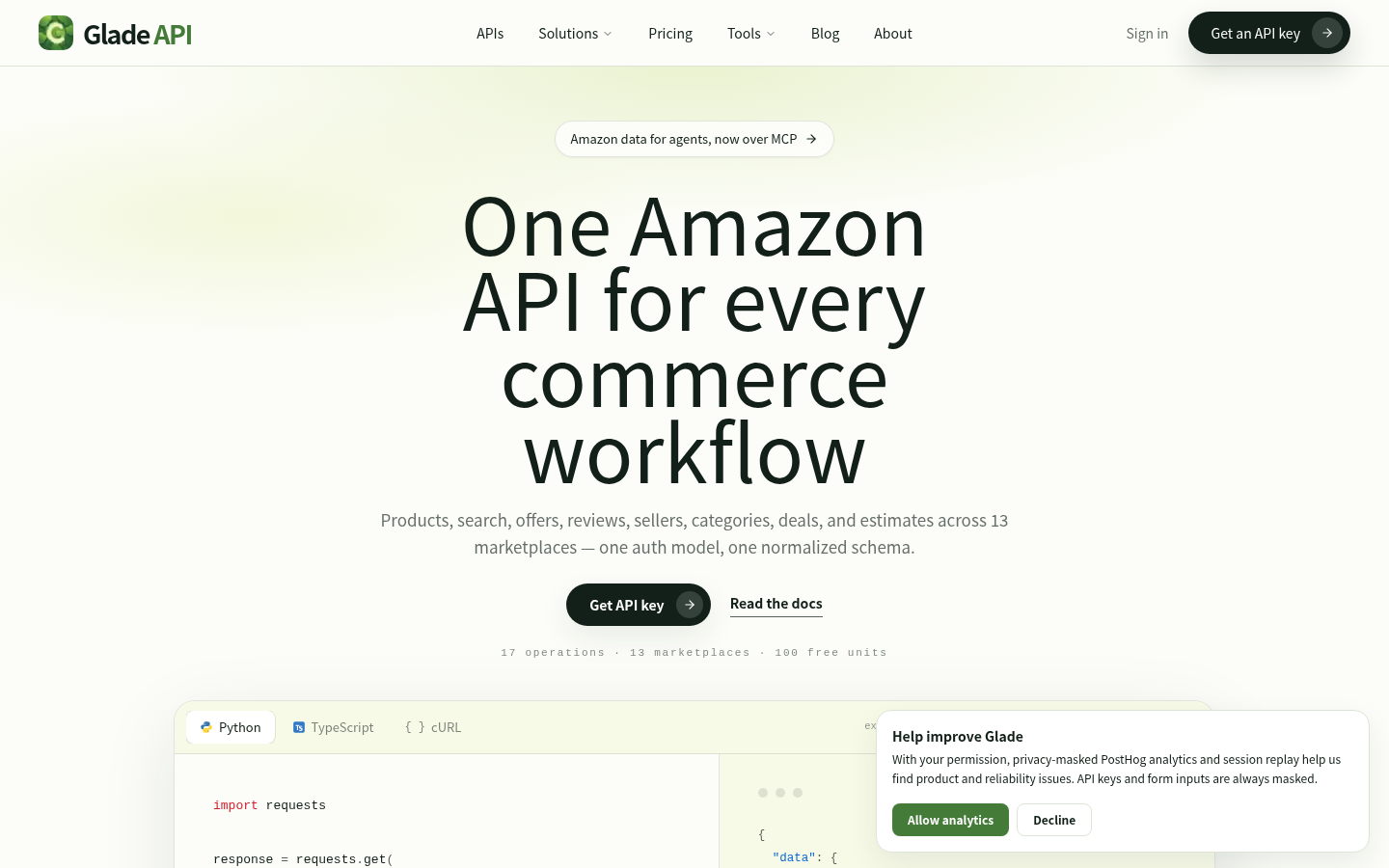
Glade API reached developers through a Show HN post by user qwikhost, not a formal product launch, and it packages eight categories of Amazon data — product, search, offer, review, seller, category, deal, and estimate — behind REST, GraphQL, or MCP access. This piece explains what each access method suits, who should use which, and where to evaluate hosting once you start building against it. It draws only on the live gladeapi.com site and the original Hacker News post, checked on 2026-08-28.
Disclosure: this article contains affiliate links. If you buy through them we may earn a commission at no additional cost to you. Our recommendations are based on the evidence recorded alongside this article, and prices were verified on the date shown.
If you build software that touches Amazon data — pricing, reviews, catalog listings — Glade API is worth a few minutes of attention. It surfaces eight categories of Amazon data through REST, GraphQL, or MCP, and it reached developers the way a lot of useful tools do now: a Show HN post, not a press release.
What changed and why it matters
Glade API showed up on Hacker News as a Show HN post titled "Show HN: Glade API," posted by user qwikhost (Show HN: Glade API – Amazon data for every build). That's the entire announcement trail — no funding round, no product-launch blog post, no press kit. Just a developer describing what they built and inviting scrutiny from other developers.
That distinction matters if you're evaluating whether to build on top of it. Show HN posts get vetted in the comments, in real time, by people who will actually use the tool. If Glade API is still standing after that scrutiny, it's because the core claim — structured access to Amazon data — held up under direct questioning from an audience that tests things before recommending them.
The detail
Glade API packages eight types of Amazon data behind one interface: product data, search results, offer data, reviews, seller data, category data, deal data, and estimate data (Glade API provides Amazon product, search, offer, review, seller, category, deal, and estimate data). That's broad enough to cover most use cases that start with "I need to pull data from Amazon" — price trackers, review aggregators, category browsers, deal-alert tools, seller research dashboards.
You reach that data through three access methods: REST, GraphQL, or MCP (Glade API data is accessible through three interfaces: REST, GraphQL, or MCP). Each fits a different kind of build:
| Access method | Best for | Skip it if |
|---|---|---|
| REST | Straightforward integrations with existing HTTP tooling and simple caching | You need multiple nested resources in a single round trip |
| GraphQL | Fetching exactly the fields you need across nested data types in one query | Your team has no GraphQL tooling in place already |
| MCP | Wiring Amazon data directly into an AI agent or assistant workflow | You're not building an AI-agent integration |
None of the three is positioned as the default. The choice comes down to what you're already building. A team shipping a REST-based backend doesn't gain much by switching to GraphQL just because it's available. A team building an AI agent that needs to reason over Amazon listings gets more out of MCP than out of either of the others.
What it means for you
Whichever access method you pick, you still have to build, run, and ship the thing that calls Glade API. That's the part that turns "interesting Show HN post" into a working feature: a deployment target for the API routes, serverless functions, or edge middleware sitting between your app and Glade API's endpoints.
That's where the decision extends past the API itself. If you're evaluating hosting for the service that will consume this data — a Next.js app polling for deals, an MCP-connected agent, a GraphQL gateway — you'll want to know what that infrastructure costs before you commit to a project that's this early in its life. [See current Vercel pricing](See current pricing at the merchant) to check what a deployment at your expected request volume would run before you build around it.
If you're weighing Vercel against other options for this kind of build, the developer-tools buying guide walks through the criteria that matter for API-backed projects specifically — deployment speed, function limits, and how each platform handles a backend that spends most of its time calling an external API.
Skip Vercel for this project if you already have serverless or edge infrastructure in place that does the job — switching platforms for one new data source isn't reason enough on its own. It's worth the evaluation if you're standing up a new service around Glade API from scratch and haven't picked a host yet.
The decision that matters here isn't REST vs. GraphQL vs. MCP. It's whether you build first and pick a host later, or price the deployment out now so the infrastructure cost doesn't surprise you once the integration is live.
What this costs right now
Vercel
The last check on this price fell outside our freshness window, so no figure is shown.
Check the current price at VercelPrices move. We print the figure we read and the moment we read it, and suppress anything older than its window rather than guess at the current number.