Context Engine: A Headless IDE for AI Coding Agents
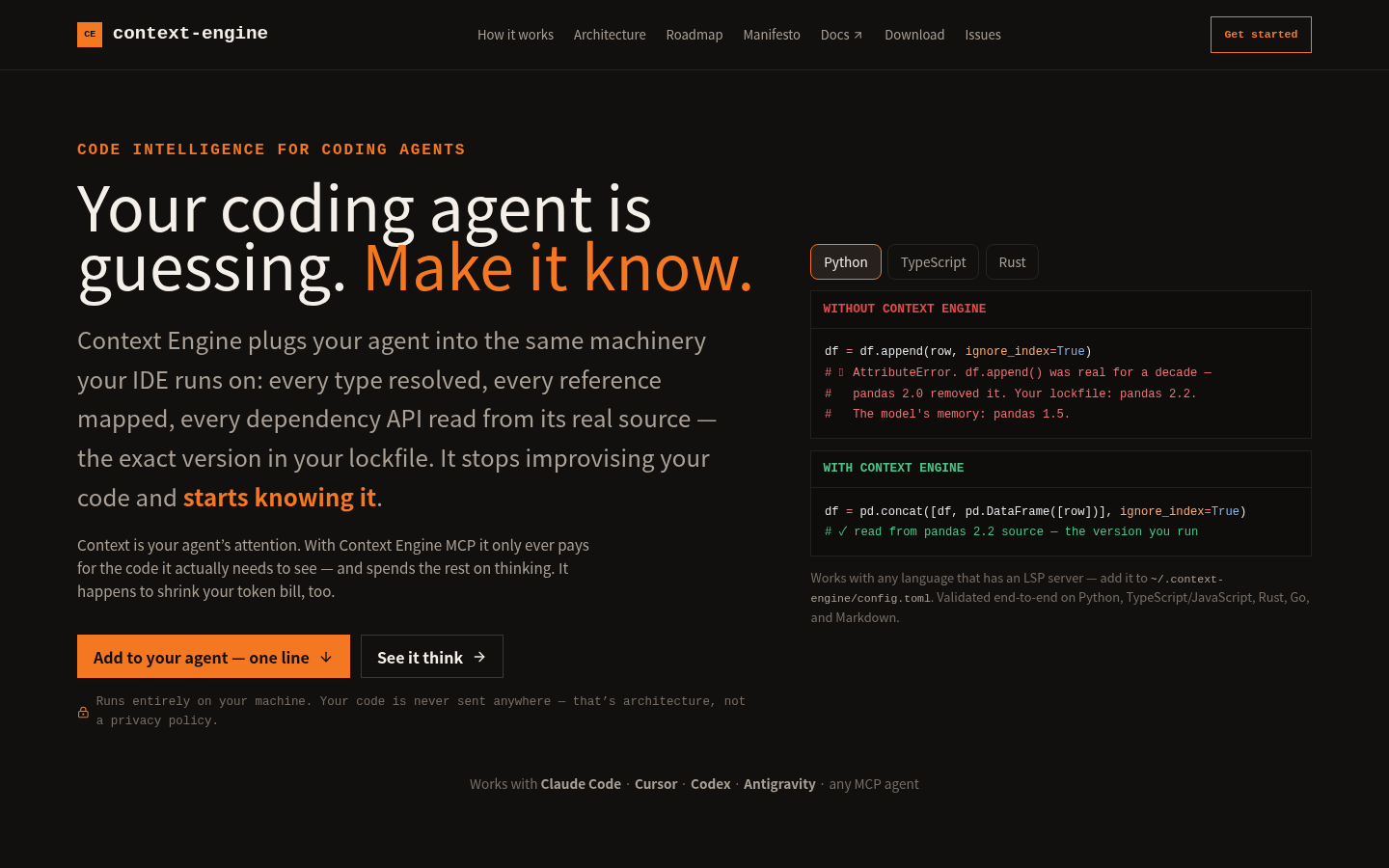
A developer using the handle 'welf' posted Context Engine to Show HN, describing it as a headless IDE built to stop AI coding agents from calling APIs that don't exist. The tool targets a documented failure mode: agents re-implementing functions already in the codebase and getting stuck in write-compile-rewrite loops. This piece explains what a headless IDE is, what problem it solves, and where to compare developer-tool options if you're evaluating your own AI-agent workflow.
Disclosure: this article contains affiliate links. If you buy through them we may earn a commission at no additional cost to you. Our recommendations are based on the evidence recorded alongside this article, and prices were verified on the date shown.
What changed and why it matters
A developer posting as "welf" put a project called Context Engine on Show HN, describing a specific and recognizable agent failure: coding assistants that call APIs that don't exist, re-implement functions already sitting in the codebase, and cycle through write-compile-rewrite loops without resolving. The Show HN title frames the fix as a "headless IDE" rather than another chat plugin bolted onto an editor.
That framing matters because it puts Context Engine in a different category than a chatbot with a linter attached — it's positioned as something closer to the code itself. The poster says the project was built last year, ahead of this Show HN post, meaning it had time in use before the public write-up.
The detail
"Headless" is doing specific work in that title. The poster's own framing draws a line between three kinds of tools: a chat plugin bolted onto an existing editor, a standalone editor with its own interface, and a headless IDE that runs without either.
| Category | What it is (per the poster's framing) |
|---|---|
| Chat plugin | A conversational assistant added on top of an editor you already use |
| Standalone editor | A new editor window replacing the one you use |
| Headless IDE (Context Engine) | Runs without its own UI, built to sit inside an agent's pipeline |
The problem Context Engine targets is described precisely on the Show HN post: AI coding agents calling APIs that don't exist, re-implementing functionality that's already defined somewhere in the codebase, and getting stuck in loops where they write code, try to compile it, fail, and rewrite. Anyone who has watched an agent burn through a context window rewriting the same broken import will recognize the pattern the poster is describing.
What it means for you
If you run AI coding agents against a real codebase, this kind of hallucination is a workflow cost, not a curiosity — wasted compile cycles, wasted context budget, and code that has to be caught manually before it ships. Context Engine is one entrant addressing that specific failure mode. Which context tool you pair with your agents is a separate decision from where those agents actually run and deploy code.
If you're weighing that second decision, start with the developer-tools buying guide before you commit to a platform. And if you want to see what a mainstream developer-tools provider currently charges for the deployment side of that stack, See current pricing at the merchant to compare plans against what your agent pipeline actually needs.
Skip a headless IDE like this one if your agents already run inside a tightly-scoped, strictly typed codebase where a compiler catches a hallucinated API call before it ships — the failure mode described here shows up hardest in large, loosely-typed projects where an agent has no easy way to verify an API exists on its own.
What this costs right now
Vercel
The last check on this price fell outside our freshness window, so no figure is shown.
Check the current price at VercelPrices move. We print the figure we read and the moment we read it, and suppress anything older than its window rather than guess at the current number.