Choosing a Data Platform After the Ceva Logistics Breach: A Buying Checklist
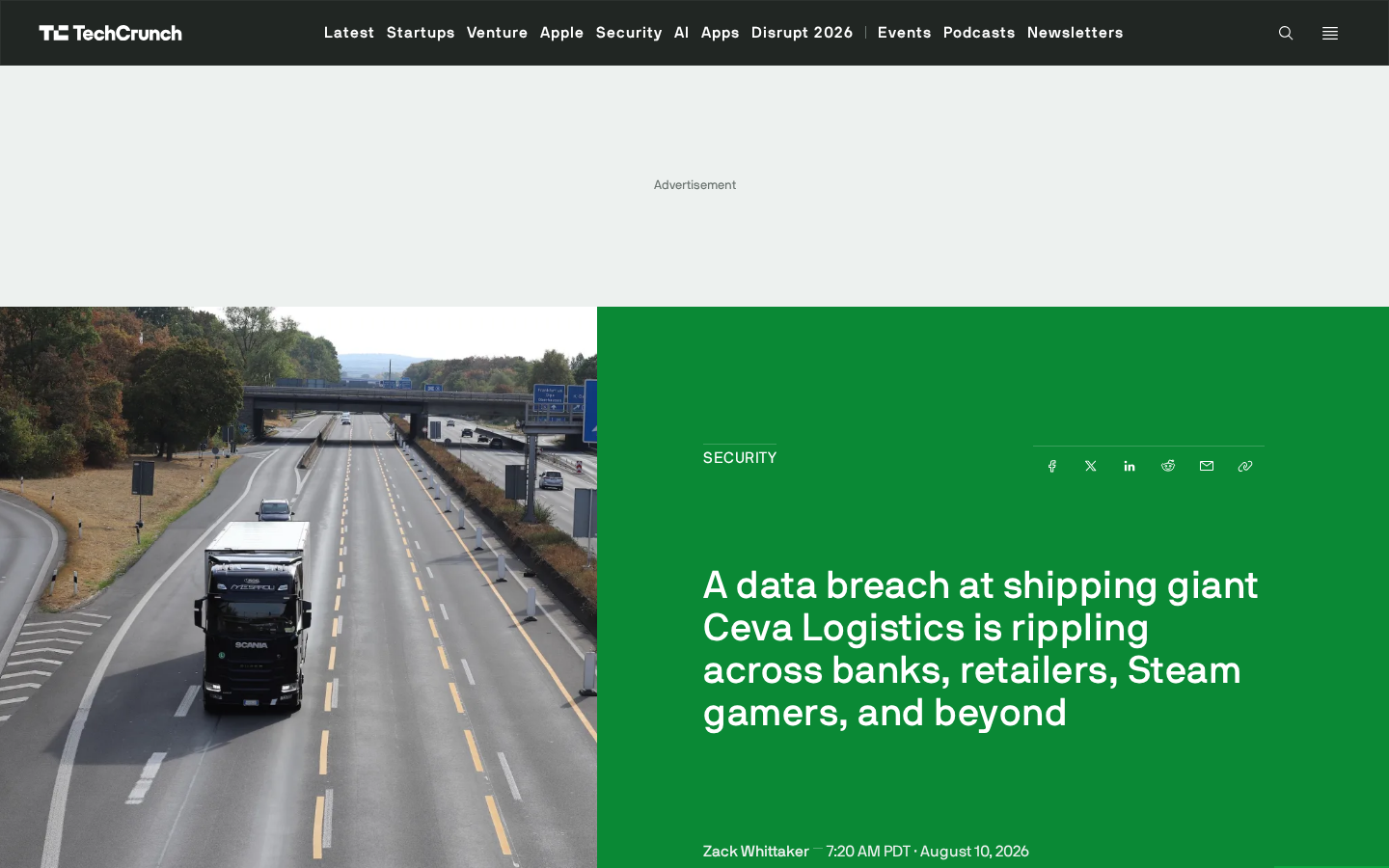
Ceva Logistics, a global shipping and logistics company, suffered a data breach reported by TechCrunch. The reported fallout rippled into banks, retailers, and Steam gamers who never chose Ceva as a vendor directly. This guide turns that pattern into a buying checklist covering breach disclosure history, access control scoping, and backup isolation for any data platform you are evaluating.
Disclosure: this article contains affiliate links. If you buy through them we may earn a commission at no additional cost to you. Our recommendations are based on the evidence recorded alongside this article, and prices were verified on the date shown.
What changed and why it matters
Ceva Logistics, a global shipping and logistics company, suffered a data breach, according to TechCrunch. The reported fallout did not stay inside Ceva's own systems — it rippled into banks, retailers, and Steam gamers, none of whom chose Ceva as their vendor directly.
That is the part worth sitting with if you are picking a place to put your own data today. A breach at one company in a supply chain can surface as fraud alerts at your bank, account resets at a retailer, or a locked game library — weeks or months after the original incident, and often before the affected company says anything public. If you are choosing a data platform, this is the live case study for why a vendor's blast-radius controls matter as much as its uptime numbers.
The detail that should change how you shop is the word "rippling." A breach report about a shipping company would normally be someone else's problem — irrelevant to a buyer comparing data platforms for their own team. What makes this one different is that the reported impact crossed industries the company had no obvious reason to touch: financial institutions, retail chains, and a gaming platform. That pattern — one vendor's incident becoming several other companies' incident — is exactly what a buying checklist needs to account for, and it's the reason this guide leads with vendor behavior rather than vendor features.
What to look for
Buyers usually start with price and features. Start instead with how a vendor behaves when something goes wrong, since that is the part you cannot fix after you have already migrated your data. The list below is ordered — treat the top rows as disqualifying if a vendor can't answer them, and the bottom rows as tie-breakers between finalists.
| Criterion | Why it matters | Ask this |
|---|---|---|
| Breach disclosure history | Shows whether the vendor tells you fast, or lets you find out from the news | Has this vendor disclosed incidents before, and how fast? |
| Access control model | Limits how far a single compromised credential reaches | Is access scoped per-project, or all-or-nothing? |
| Encryption at rest and in transit | Reduces what a breach actually exposes | Is encryption on by default, or an add-on? |
| Incident response process | Determines how fast containment happens | Is there a published incident response process? |
| Data retention and minimization | Less stored data means less to lose | Can you set retention limits yourself? |
| Backup and redundancy | Separates "breached" from "breached and lost" | Are backups isolated from the primary environment? |
Rank these in this order for a reason: disclosure history tells you what the vendor will do the day something goes wrong, and everything else is damage control after that day. A platform with perfect encryption but no disclosure practice still leaves you finding out about problems from a news article instead of an email — which is close to what happened to the organizations pulled into the Ceva Logistics story, where the reported effects reached banks, retailers, and Steam gamers who were not the ones with a direct relationship to Ceva.
Skip vendors that cannot answer the access-control question in plain language. If a sales team cannot describe how access is scoped, the engineering team likely has not scoped it either. That gap tends to show up first as a support ticket that takes days to escalate, and only later as the reason a small compromise turned into a large one.
A few of these criteria deserve a longer look before you shortlist anyone.
Breach disclosure history. Ask a prospective vendor directly whether they have disclosed a security incident before, and how long it took from detection to notification. A vendor that has never had to answer this question in public hasn't necessarily avoided incidents — it may just not have told you about them yet. What you're really testing is whether the vendor treats disclosure as a checkbox or a habit.
Access control model. The difference between per-project scoping and all-or-nothing access decides how far a single stolen credential travels inside the system. A platform where every login reaches every dataset turns one phished employee into a company-wide event; a platform with strict scoping turns the same phishing incident into a contained one.
Backup and redundancy. A backup stored in the same environment as your production data is not really a backup — it's a second copy of the same target. Ask whether backups live in an isolated environment, and whether the vendor has a documented recovery-time objective you can hold them to.
Recommended options
Map your actual need to the platform type before you compare individual brands. Each option below trades off differently against the criteria above, and each has a buyer it doesn't suit.
Managed cloud platform (e.g., Vercel)
Best for: teams that want infrastructure, deployment, and the underlying security patching handled by the platform rather than an in-house ops team, so engineering time goes into the product instead of server maintenance.
Skip it if: your compliance requirements demand full control over physical infrastructure or a specific on-premises data residency that a managed platform does not support.
Check before you buy: how the platform scopes access between projects and teams, and whether its incident-disclosure practices are documented anywhere public — not just implied by its reputation.
Self-hosted stack
Best for: teams with the engineering capacity to own patching, access control, and incident response end to end, and who need infrastructure-level control that managed options don't offer.
Skip it if: you don't have a dedicated team to maintain it. An unpatched self-hosted system is a bigger risk than a managed one, not a smaller one — the control only pays off if someone is actually exercising it every week.
Check before you buy: whether your team has the bandwidth to run the same disclosure and backup practices in-house that a managed vendor would be expected to run for you.
Specialized backup and disaster-recovery layer on top of either option
Best for: anyone running production data through either option above who wants backups isolated from the primary environment, so a breach or outage in production doesn't take the backup down with it.
Skip it if: your data volume and change rate are low enough that your primary platform's built-in backup already meets your recovery-time needs — in which case a second vendor adds cost and complexity without adding protection.
Check before you buy: where the backup actually lives, and whether restoring from it has ever been tested rather than just scheduled.
None of these choices is complete on its own. The Ceva Logistics case is a reminder that even a large, established vendor can become the weak link for organizations several steps removed from it. The platform you pick matters less than the habits you build around checking it — disclosure history, access scoping, and tested backups apply whether you're evaluating a managed platform, a self-hosted stack, or the layer you add on top of either.
Common mistakes
Choosing on price or features alone. A cheaper plan with no visible incident-response process is not actually cheaper once you count the cost of a slow breach response. Feature checklists are easy to compare side by side; they don't tell you anything about what the vendor does in the first hour after detecting a problem, which is usually the detail that determines how bad an incident gets.
Assuming a compliance badge means no breach can happen. Certifications describe a process that was followed at audit time — they don't describe what happens the day an incident actually hits. Treat a badge as evidence the vendor has documentation, not evidence the vendor is immune.
Ignoring downstream exposure. The reported effects of the Ceva Logistics breach extended to banks, retailers, and Steam gamers — organizations and individuals who never signed a contract with Ceva directly. That's the pattern to ask about before you sign anything: which other companies, subprocessors, or partners can touch your data through this vendor, and what happens to your exposure if one of those third parties is the one that gets breached instead of the vendor you actually chose.
Treating vendor pricing as fixed. Plans, limits, and included security features change over time, and a screenshot from someone else's year-old blog post is not a reliable basis for a decision you're making today. Before you commit to any platform, see current pricing at the merchant and compare it line by line against the criteria above — See current pricing at the merchant — so your comparison reflects what the vendor actually offers right now.
Never testing your own recovery. A backup you have not restored from is a theory, not a plan. Scheduling backups is the easy half of the job; proving you can bring data back from them, on a timeline you can live with, is the half that actually gets tested during a real incident.
Reading "encrypted" as a finished answer. Encryption at rest and in transit is a baseline, not a differentiator — ask specifically whether it's on by default or something you have to configure yourself, since a feature you forgot to enable protects nothing.
Whether the vendor's disclosure habits, access controls, and backup separation hold up on the day something goes wrong matters more than any marketing page. The reported effects of the Ceva Logistics breach reached banks, retailers, and Steam gamers who never chose Ceva directly, and that pattern has a way of arriving for someone else's customers too.
What this costs right now
Vercel
The last check on this price fell outside our freshness window, so no figure is shown.
Check the current price at VercelPrices move. We print the figure we read and the moment we read it, and suppress anything older than its window rather than guess at the current number.