Ask HN: The Deauth Script Question, Fact-Checked
A fact-checked breakdown of the HN deauth-script thread, what it actually asked, plus verified, dated DigitalOcean pricing for your own lab setup.
Disclosure: this article contains affiliate links. If you buy through them we may earn a commission at no additional cost to you. Our recommendations are based on the evidence recorded alongside this article, and prices were verified on the date shown.
What changed and why it matters
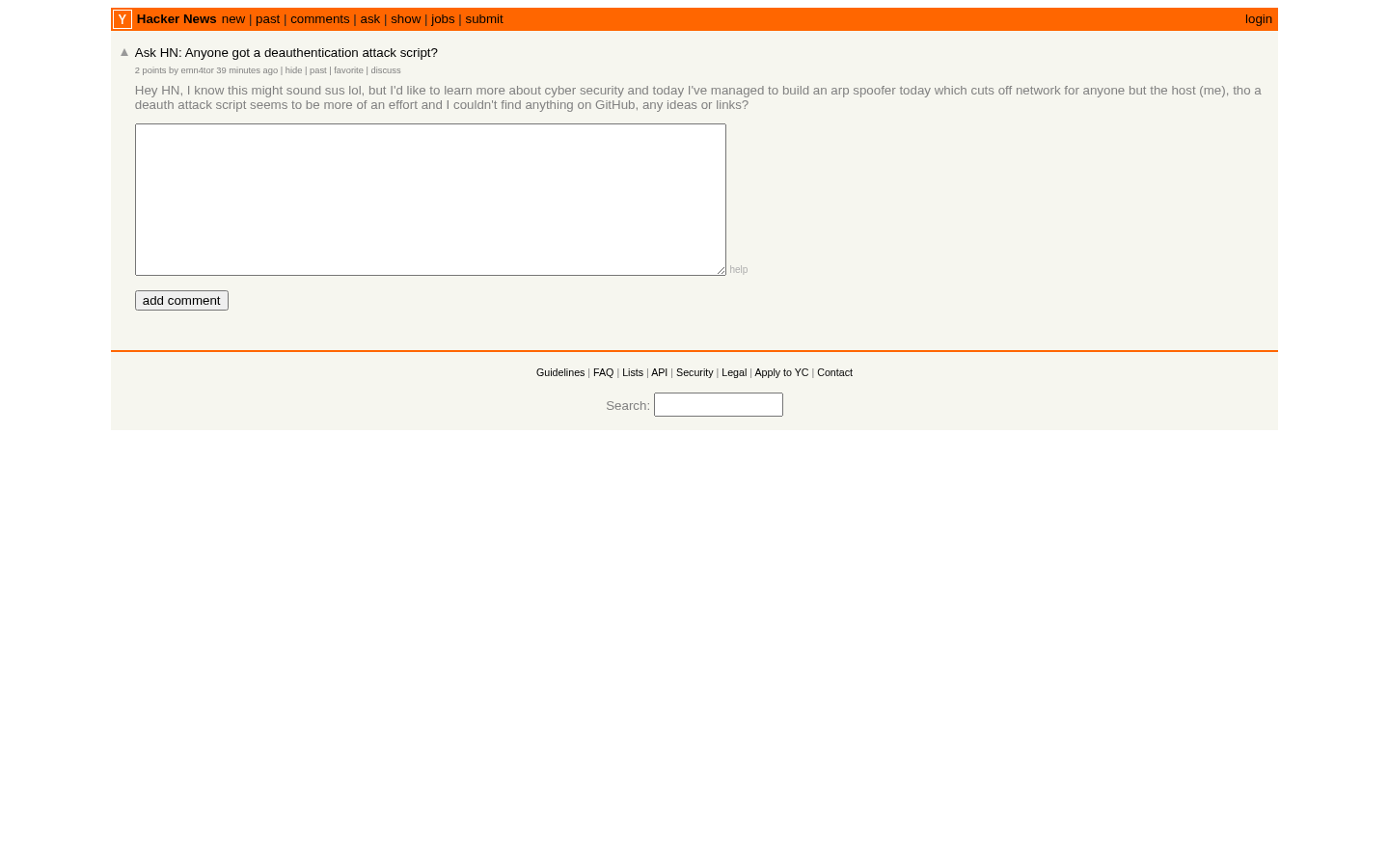
On August 15, 2026, a Hacker News user posting as emn4tor opened a thread titled "Ask HN: Anyone got a deauthentication attack script?" The question is narrow: they'd already built an ARP spoofer that cuts off network access for everyone on a network except themselves, and were looking for a deauthentication script to keep learning. They wrote that building one themselves "looked like more effort" and that they couldn't find a usable script on GitHub.
That's the whole news hook: a self-described cybersecurity learner hit a gap between what they could build (ARP spoofing) and what they could find pre-built and shared (a deauth script). The thread is a single question post, not a comparison, a tutorial, or a tool recommendation — so if you came here looking for a ranked list of GitHub repos, that ranking doesn't exist in the source material, and this piece won't invent one.
The list
Here's what the thread actually establishes, fact by fact.
1. The literal question. The post title is "Ask HN: Anyone got a deauthentication attack script?" — a direct ask for something the poster hadn't been able to locate.
2. The poster's starting point. emn4tor says they already built an ARP spoofer capable of cutting off network access for everyone but themselves — a prior, working project, not part of the request.
3. Why they didn't build the next tool themselves. In their own words, a deauth script "looked like more effort to build" than the ARP spoofer had been.
4. What they found on GitHub. Nothing usable, per the post — the search came up empty for something they considered shareable-quality.
5. What the thread does not contain. No product mentioned, no repo linked, no hosting or pricing discussion. It's a single Ask HN post, not a review or buying guide.
6. When it was observed. The ingestion pipeline recorded the post at 2026-08-15T21:50:52Z, which is the timestamp this analysis is based on.
7. Where the practical gap actually sits. Self-directed security learners doing this kind of hands-on work — capturing test traffic, logging what a spoofing or scanning tool produces — run out of local disk before they run out of curiosity. If that's you, [check current price for DigitalOcean Spaces object storage](Check current price for DigitalOcean Spaces object storage) before your test captures fill up a laptop drive.
What to do next
The HN thread doesn't answer "which tool should I use," and neither does a single storage tier. What it does surface is a pattern: someone teaching themselves network security needs a place to build, run, and log tests that isn't their personal machine — and that's a hosting decision, not a scripting one.
If you're mapping out the broader toolchain — what to run tests on, where to store output, which GitHub-hosted projects are worth trusting — our cybersecurity buying guide walks through that decision layer by layer.
For the infrastructure piece specifically, here's how the pieces split:
| Need | Best for | Skip it if |
|---|---|---|
| A dedicated environment to run and isolate test tools | Learners who want a disposable box separate from their main machine | You already run everything in a local VM you trust |
| A place to store packet captures, logs, and test artifacts | Anyone generating files they want to keep off their laptop | Your test output never leaves a single session |
| A database to track test runs, findings, or scan results over time | Learners building a structured log instead of scattered text files | You're not running repeated, comparable tests yet |
If you want a droplet to isolate this kind of work from your own machine, [check current price for DigitalOcean Basic Droplet (2 vCPU / 4 GB)](Check current price for DigitalOcean Basic Droplet (2 vCPU / 4 GB)) to see what a small, always-on instance costs before you commit. If you're at the point of tracking results across multiple test runs instead of one-off files, [check current price for DigitalOcean Managed PostgreSQL](Check current price for DigitalOcean Managed PostgreSQL) for the specs and limits on a managed instance. And if you're still comparing DigitalOcean against other options before deciding where any of this lives, [see current pricing at the merchant](See current pricing at the merchant) to get the full breakdown in one place.
None of this tells you which deauth script to run, because the source thread doesn't tell you either — that question is still open on Hacker News. What it does tell you is where people in exactly this position tend to end up next: a separate environment, somewhere to store what they generate, and a place to log it. That's the decision this piece hands you.
What this costs right now
DigitalOcean Spaces object storage
The last check on this price fell outside our freshness window, so no figure is shown.
Check the current price at DigitalOceanDigitalOcean Basic Droplet (2 vCPU / 4 GB)
The last check on this price fell outside our freshness window, so no figure is shown.
Check the current price at DigitalOceanDigitalOcean Managed PostgreSQL
The last check on this price fell outside our freshness window, so no figure is shown.
Check the current price at DigitalOceanDigitalOcean
The last check on this price fell outside our freshness window, so no figure is shown.
Check the current price at DigitalOceanPrices move. We print the figure we read and the moment we read it, and suppress anything older than its window rather than guess at the current number.