A Hacker News Ask-for-Marketing-Advice Thread Is a Case Study in When to Upgrade Your Infrastructure
An Ask HN thread about marketing a self-built licensing layer shows a working funnel with an acquisition bottleneck. Here's the infrastructure question that raises.
Disclosure: this article contains affiliate links. If you buy through them we may earn a commission at no additional cost to you. Our recommendations are based on the evidence recorded alongside this article, and prices were verified on the date shown.
A developer posted on Hacker News asking how to market a software licensing layer they built for their own apps. The specifics in that thread say more about early-stage SaaS distribution than most marketing guides do, and they point straight at an infrastructure decision worth making before signup volume grows.
What changed and why it matters
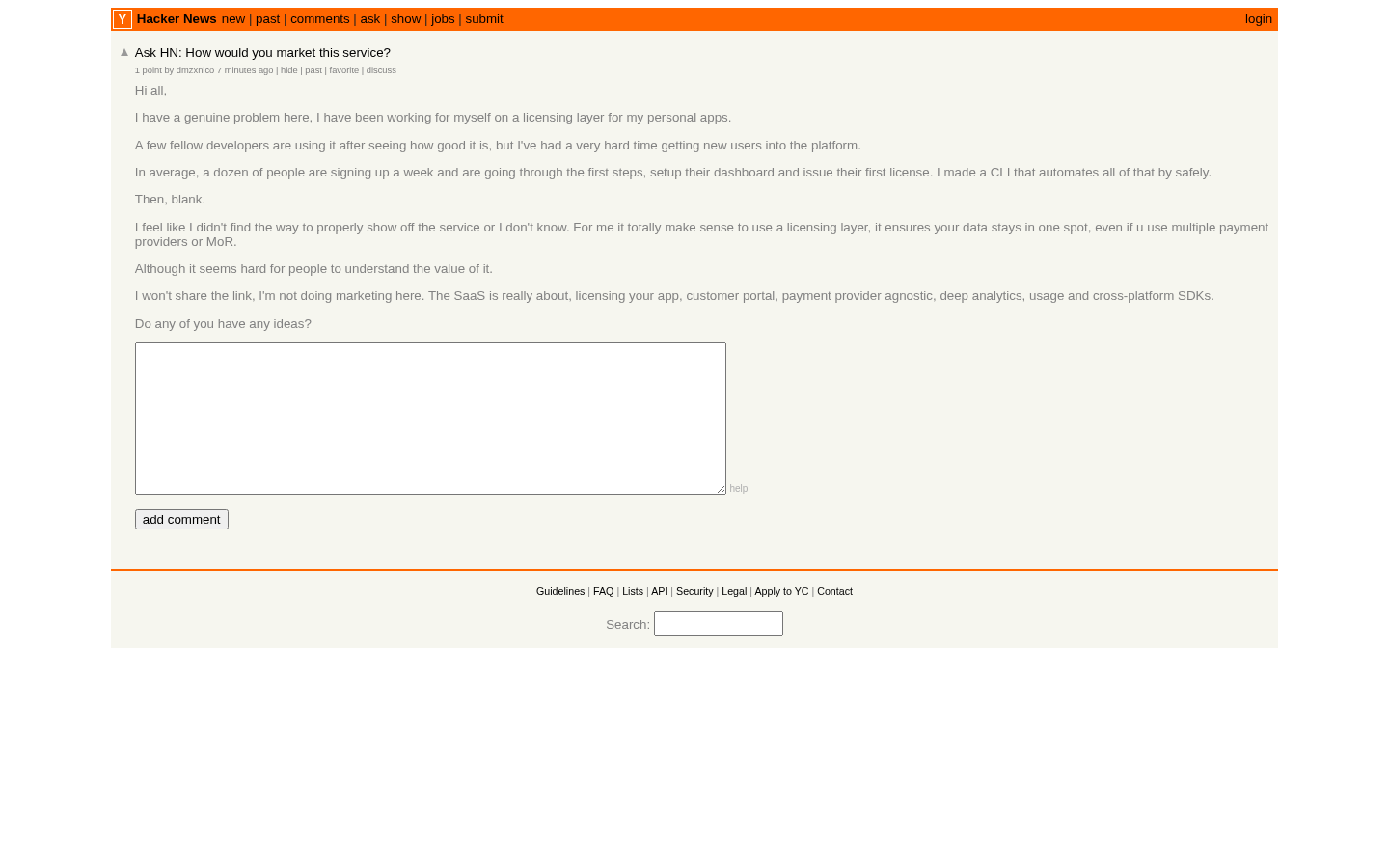
On Hacker News, user dmzxnico opened a thread titled "Ask HN: How would you market this service?" (item 49316403) asking the community for marketing advice on a self-built licensing layer for personal apps. The post states plainly that a few fellow developers already use the tool after seeing how good it is, and that roughly a dozen people sign up per week and go on to set up a dashboard and issue a first license.
That matters because the poster names the problem explicitly: getting new users onto the platform is hard, not proving the product works. A tool with organic peer adoption and a funnel that converts signups into activated users (dashboard set up, first license issued) does not have a product-validation problem. It has an acquisition problem, and acquisition problems get solved with distribution work and infrastructure that can absorb the traffic that work generates.
The list
- The ask is narrowly about marketing, not the product. The thread title and body ask how to market the service, not whether it is good. That framing is the poster's own, per the original post.
- Peer adoption is already evidence of quality. A few fellow developers are using the licensing layer after seeing how good it is, which is a stronger signal than cold-outreach interest because it came unprompted.
- A dozen weekly signups is a real number, not a guess. The poster reports this average explicitly, giving a baseline any growth channel can be measured against.
- The funnel converts past signup. Those weekly signups go on to complete onboarding: setting up a dashboard and issuing a first license. That is two completed actions past account creation, not just a registered email.
- The stated bottleneck is top of funnel, not activation. The poster frames the difficulty as getting new users onto the platform in the first place, which points at reach and channels rather than product friction.
- A licensing layer means the product itself stores and serves data other apps depend on — license keys, issuance logs, dashboard assets. Anywhere this kind of service adds distribution channels (downloads, docs, public assets), it needs storage that will not need re-architecting as traffic grows; you can [check current price for DigitalOcean Spaces object storage](Check current price for DigitalOcean Spaces object storage) to see what that costs at the tier this kind of project typically starts at.
- The thread is a single data point, not a case study. Everything here comes from one Ask HN post; treat it as a snapshot of one founder's numbers, not a benchmark for what "good" acquisition looks like at this stage.
What to do next
A licensing layer with organic peer adoption and a converting signup funnel is a candidate for scaling distribution, and scaling distribution means the backend has to hold up before you know which channel works. Three pieces of infrastructure map directly onto what this kind of service needs as weekly signups grow past a dozen:
| Component | Best for | Skip it if |
|---|---|---|
| Object storage (Spaces) | Serving license assets, docs, or downloads without re-architecting later | You have no static assets or downloads tied to the product yet |
| Compute (Basic Droplet, 2 vCPU / 4 GB) | Running the licensing API and dashboard | You're still validating on a free-tier host and traffic is flat |
| Managed database (PostgreSQL) | Storing license records and dashboard state without running your own database ops | A single-file or embedded database still covers your current load |
If the marketing push in that Ask HN thread works, the app needs a server that can take the traffic without a rebuild mid-launch: [check current price for a DigitalOcean Basic Droplet with 2 vCPU and 4 GB of RAM](Check current price for DigitalOcean Basic Droplet (2 vCPU / 4 GB)) to see what that headroom costs before you need it.
License records and dashboard state are exactly the kind of data you do not want to lose or lock yourself out of during a growth spike, which is what a managed database is for: [check current price for DigitalOcean Managed PostgreSQL](Check current price for DigitalOcean Managed PostgreSQL) to compare it against running your own instance.
For a wider view of which SaaS infrastructure tiers fit which growth stage, the saas-productivity buying guide breaks down the same tradeoffs across more categories than storage, compute, and database alone. And if none of the above tiers match your current numbers, [see current pricing at the merchant](See current pricing at the merchant) to find the plan that does.
The decision here is not whether the product works — the thread's own numbers say it does. It is whether the infrastructure underneath it can take a real marketing push without becoming the next thing you have to fix.
What this costs right now
DigitalOcean Spaces object storage
The last check on this price fell outside our freshness window, so no figure is shown.
Check the current price at DigitalOceanDigitalOcean Basic Droplet (2 vCPU / 4 GB)
The last check on this price fell outside our freshness window, so no figure is shown.
Check the current price at DigitalOceanDigitalOcean Managed PostgreSQL
The last check on this price fell outside our freshness window, so no figure is shown.
Check the current price at DigitalOceanDigitalOcean
The last check on this price fell outside our freshness window, so no figure is shown.
Check the current price at DigitalOceanPrices move. We print the figure we read and the moment we read it, and suppress anything older than its window rather than guess at the current number.